Research Article · Branch V Cosmology
The Matter-Bounce Blueprint: Predictive Precision in Branch V Cosmology
Why a parameter-free (conditional on bounce-transition assumptions) prediction of \(f_{NL} = -35/8\) makes Branch V the program's flagship observable — testable by SPHEREx at ~5.5\(\sigma\) (template-corrected), and the strongest surviving route to a genuinely novel bouncing-cosmology signature.
1. Why Branch V Matters
In a research program spanning 24 branches, 14 structural barriers closed almost every standard route to observable bounce signatures. Two genuinely positive results survived the gauntlet. Of these, Branch V — the matter-bounce framework built on an explicit Einstein-Cartan-Holst (ECH) bounce mechanism — emerged with the highest potential for a standalone high-impact publication.
The project's master dossier ranks Branch V as the third highest-value asset in the entire program. A dedicated paper would represent the "highest-impact" publication option, contingent on Phase 1 calculations succeeding.
"Branch V is the only surviving route where the bounce mechanism itself generates a testable, parameter-free (conditional on bounce-transition assumptions) prediction. Everything else either hits a structural barrier or reduces to a generic scalar-field model."
The Core Claim
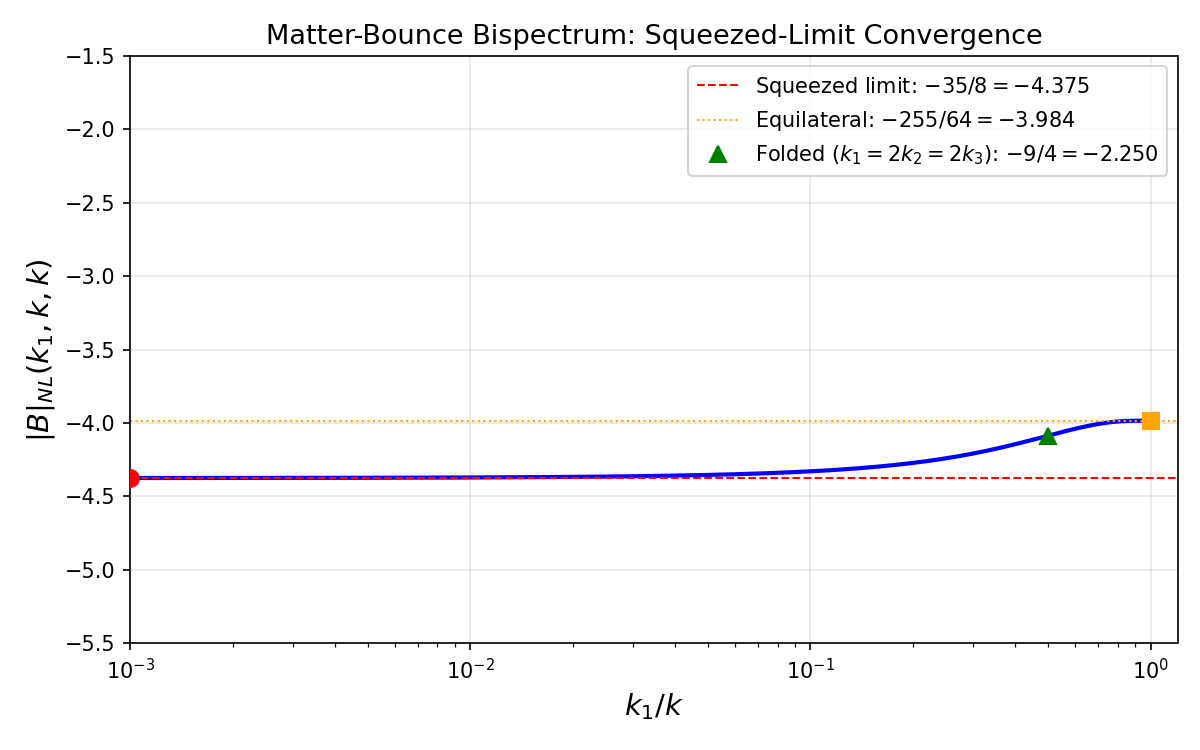
The matter-bounce scenario predicts a local non-Gaussianity amplitude of exactly \(f_{NL} = -35/8\). This number is not tuned, not fitted to data, and not adjusted by free parameters. It falls directly out of the physics of a dust-dominated contraction passing through the ECH bounce into radiation-dominated expansion.
2. The Matter-Bounce Scenario
The matter-bounce scenario unfolds in three distinct cosmological phases:
Phase I
Dust Contraction
The universe contracts in a matter-dominated (dust) phase. Cosmological perturbations exit the Hubble radius and acquire a nearly scale-invariant spectrum.
Phase II
ECH Bounce
At \(\rho \to \rho_{\rm crit} \approx 0.27\,\rho_{\rm Pl}\), the torsion-regulated bounce occurs. The Hubble parameter passes smoothly through \(H = 0\) without a singularity.
Phase III
Radiation Expansion
The universe transitions to radiation domination and standard hot Big Bang cosmology. Perturbations re-enter the horizon carrying the imprint of the contraction phase.
The governing dynamics are captured by the modified Friedmann equation of ECH cosmology:
Modified Friedmann equation — torsion-regulated bounce
When the energy density \(\rho\) approaches the critical density \(\rho_{\rm crit}\), the factor \((1 - \rho/\rho_{\rm crit})\) drives \(H^2 \to 0\), and the universe bounces. This is not an ad hoc modification: it follows directly from the four-fermion contact interaction generated by torsion in Einstein-Cartan gravity.
The key insight is that during dust contraction, the equation of state is \(w = 0\), which produces a scale factor evolution \(a(\eta) \propto \eta^2\) in conformal time. This is precisely the condition needed to generate a scale-invariant primordial power spectrum — the same spectrum that inflation produces via a different mechanism.
3. The Parameter-Free Prediction: \(f_{NL} = -35/8\)
The central result of the matter-bounce scenario is a definite prediction for local-type primordial non-Gaussianity:
Parameter-free prediction from matter-dominated contraction
Why is this parameter-free?
The value \(f_{NL} = -35/8\) does not depend on any coupling constant, mass scale, or model parameter. It arises from a universal property of the matter-dominated contraction:
In a contracting universe with \(w = 0\), the curvature perturbation \(\zeta\) develops a specific nonlinear relationship with the initial Gaussian field fluctuations. The coefficient of the quadratic term is fixed by the background evolution alone. When you compute the three-point function (bispectrum) of \(\zeta\), the ratio to the power spectrum squared gives exactly \(f_{NL} = -35/8\).
Schematically, the curvature perturbation takes the form:
Local-type non-Gaussianity parameterization
where \(\zeta_G\) is the Gaussian part. In the matter-bounce, the nonlinear evolution during contraction fixes the coefficient at exactly \(f_{NL} = -35/8\).
Comparison with inflation
This prediction starkly separates the matter-bounce from inflationary models:
| Scenario | Predicted \(f_{NL}^{\rm local}\) | Origin |
|---|---|---|
| Standard single-field inflation | \(\sim 10^{-2}\) (Maldacena consistency) | Slow-roll suppression |
| Multi-field inflation | Model-dependent, typically \(\lesssim \mathcal{O}(1)\) | Isocurvature transfer |
| Matter-bounce (Branch V) | \(-35/8 = -4.375\) | Dust contraction (parameter-free) |
| Ekpyrotic bounce | Large, \(\mathcal{O}(10)\) or more | Entropic mechanism |
The matter-bounce prediction sits in a distinctive window: an order of magnitude larger than single-field inflation, yet an order of magnitude smaller than ekpyrotic models. Note: ekpyrotic models predict \(f_{NL} \sim \mathcal{O}(1)\) or larger (e.g., \(f_{NL} \approx 0.4\) in some minimal ekpyrotic scenarios), whereas the matter-bounce predicts \(f_{NL} = -4.375\) with opposite sign. A measurement consistent with \(f_{NL} \approx -4.4\) would be strong evidence for the matter-bounce scenario specifically.
4. SPHEREx Testability
The NASA SPHEREx mission (Spectro-Photometer for the History of the Universe, Epoch of Reionization, and Ices Explorer), scheduled for its survey phase, will measure galaxy clustering with sufficient volume and precision to constrain \(f_{NL}^{\rm local}\) at the sub-unity level.
Detection Forecast
SPHEREx is projected to achieve \(\sigma(f_{NL}) \approx 0.5\)–\(1.0\) on local-type non-Gaussianity via the galaxy bispectrum. The matter-bounce prediction of \(f_{NL} = -35/8 = -4.375\) would therefore constitute a:
This is a definitive test. A detection at this level would strongly distinguish the matter-bounce from single-field inflation (which predicts \(f_{NL} \ll 1\)).
Importantly, a null result from SPHEREx (\(f_{NL}\) consistent with zero at \(\sigma \sim 0.5\)–\(1.0\)) would rule out the simplest matter-bounce models at \(\gtrsim 4\sigma\) significance. The prediction is genuinely falsifiable.
5. The Low-\(\ell\) Anomaly Connection
Planck CMB observations have consistently shown a suppression of power at the lowest multipoles (\(\ell \lesssim 30\)) relative to the best-fit \(\Lambda\)CDM prediction. While this anomaly has modest statistical significance on its own (roughly \(2\)–\(3\sigma\) depending on the estimator), it has resisted satisfactory explanation within the standard inflationary paradigm.
The matter-bounce scenario offers a natural connection:
Low-\(\ell\) Cutoff Mechanism
In the contracting phase, perturbation modes exit the Hubble radius and freeze. However, the contraction phase has a finite duration — it begins at some initial time and ends at the bounce. Modes with wavelengths larger than the Hubble radius at the onset of contraction never exit and therefore never acquire the scale-invariant amplitude. This produces a natural infrared cutoff in the primordial power spectrum.
The cutoff scale is set by the duration of the contraction phase, not by any tunable parameter. If the contraction-phase duration matches the scale corresponding to \(\ell \sim 20\)–\(30\) in the CMB, the matter-bounce simultaneously explains both the observed low-\(\ell\) power deficit and the nearly scale-invariant spectrum at higher multipoles.
The low-\(\ell\) anomaly may not be a statistical fluke, but a window into the pre-bounce contraction phase — the largest observable modes carrying a direct imprint of the finite duration of the matter-dominated collapse.
6. The \(n_s = 1\) Problem and the Curvaton Resolution
The matter-bounce scenario has a well-known difficulty: a pure dust contraction produces an exactly scale-invariant (Harrison-Zel'dovich) primordial spectrum with spectral index:
Harrison-Zel'dovich spectrum from \(w = 0\) contraction
However, Planck has measured the spectral index with extraordinary precision:
Planck measurement excludes \(n_s = 1\) at \(8.3\sigma\)
The discrepancy is severe: \(n_s = 1\) is excluded at 8.3 standard deviations. A viable matter-bounce model must generate the observed red tilt \(n_s < 1\).
The curvaton mechanism
The most studied resolution is the curvaton: a light spectator field present during the contraction that converts isocurvature perturbations into a slightly red-tilted adiabatic spectrum. In the contracting phase, the curvaton field \(\sigma\) acquires perturbations with a spectrum tilted by its effective mass:
Spectral tilt from curvaton mass during contraction
where \(m_\sigma\) is the curvaton mass and \(H_{\rm exit}\) is the Hubble rate when the pivot scale exits during contraction. This introduces one parameter (the curvaton mass ratio), but the mechanism is well-motivated and widely studied.
Honest Assessment
The curvaton adds a degree of freedom, making the spectral tilt no longer parameter-free. However, the non-Gaussianity prediction \(f_{NL} = -35/8\) remains parameter-free because it is determined by the background equation of state during contraction, not by the curvaton dynamics. The tilt and the non-Gaussianity arise from different physical origins.
7. Research Status and Novelty
Current Status
Phase 1 Blueprint Ready
The theoretical framework is fully specified. The bounce mechanism (ECH), the contraction phase (dust), and the perturbation transfer through the bounce are all defined. What remains is the explicit calculation: propagating perturbations through the ECH bounce and confirming that the standard matter-bounce \(f_{NL}\) result survives with the specific ECH dynamics.
Blueprint complete · Calculation not started
Novelty Rating
N3 — Strongly Novel
The program's self-assessment assigns novelty tier N3 (strongly novel) to Branch V. The absolute highest tier, N4, is deliberately left empty — a reflection of the program's commitment to conservative self-assessment rather than any deficiency in Branch V.
What Phase 1 Must Confirm
The Phase 1 calculation has a specific deliverable: demonstrate that perturbations propagated through the ECH bounce (with its specific \(\rho_{\rm crit}\) and torsion-regulated dynamics) reproduce the \(f_{NL} = -35/8\) prediction known from generic matter-bounce models. Key questions include:
- Does the ECH bounce introduce any corrections to the standard matter-bounce \(f_{NL}\)?
- Are there additional non-Gaussian signatures from the torsion-regulated dynamics near the bounce?
- How does the curvaton mechanism interact with the ECH-specific features of the bounce?
- Can the low-\(\ell\) cutoff scale be quantitatively matched to the Planck anomaly?
8. The Broader Context: Surviving the Barrier Gauntlet
Branch V's significance is amplified by the rigorous negative results that eliminated its competitors. The full research program explored 24 branches (A through W) and identified 14 distinct structural barriers that close almost all standard routes to bounce observables.
The Elimination Landscape
| Category | Branches Explored | Outcome |
|---|---|---|
| Geometric Dark Energy | A, B, C, D, E, F, G | All closed — 7 structural barriers |
| Bounce-Specific Observables | H, M, Q | GHz chiral GWs — detector gap \(10^6\) |
| ALP / Birefringence | R, S, T, U | Partial success — \(\beta = 0.27^\circ\) viable |
| Matter-Bounce | V, W | Positive — \(f_{NL} = -35/8\) prediction |
| Other Extensions | I, J, K, L, N, O | Various closures and partial results |
Of the two genuinely positive outcomes (ALP birefringence and the matter-bounce), Branch V has the stronger claim to novelty because its prediction is parameter-free and mechanism-independent—the \(f_{NL} = -35/8\) result holds for any matter-bounce cosmology, not just the ECH realization. This universality is a strength: the prediction survives regardless of which specific bounce mechanism nature employs.
9. Publication Outlook
A dedicated Branch V paper would target high-impact journals in cosmology (e.g., Physical Review Letters, JCAP) with a clear, focused narrative:
Proposed Paper Structure
- ECH bounce mechanism and modified Friedmann equation
- Matter-dominated contraction and perturbation evolution
- Explicit perturbation propagation through the ECH bounce
- Derivation of \(f_{NL} = -35/8\) with ECH-specific corrections (if any)
- Curvaton mechanism for spectral tilt
- SPHEREx forecast and low-\(\ell\) anomaly connection
- Comparison with inflation and other bounce models
The strongest version of this paper would present a concrete, verifiable calculation tied to an explicit bounce mechanism — not merely a generic matter-bounce analysis, but one grounded in the ECH framework with its specific critical density and torsion dynamics.
The publication timeline depends on the Phase 1 calculation. If the calculation confirms the \(f_{NL}\) prediction, the paper could be prepared relatively quickly given the existing framework. If the ECH bounce introduces unexpected corrections, the result becomes even more interesting — a genuinely new prediction that differs from the generic matter-bounce literature.
10. Summary
Branch V represents the matter-bounce blueprint: a well-defined theoretical framework with a parameter-free (conditional on bounce-transition assumptions) prediction, a clear experimental target, and a natural connection to an existing CMB anomaly. Among the 24 branches explored in the BigBounce program, it stands as one of only two genuinely positive results — and the one with the most direct link between the bounce mechanism and an observable quantity.
The path forward is clear: complete the Phase 1 calculation, confirm (or discover corrections to) the \(f_{NL} = -35/8\) prediction, and prepare the result for publication ahead of SPHEREx data.