March 2026 · gr-qc · astro-ph.CO · hep-th
What If the Big Bang
Was a Big Bounce?
Standard cosmology starts with a singularity — a moment where the math breaks down and physics has nothing to say. Bounce cosmology offers a singularity-free alternative: the universe contracted before expanding, and that contraction left testable fingerprints. We built the first comprehensive test suite for this hypothesis: four papers (two theoretical ready for submission, an AI-driven catalog of 195K uncharacterized objects from DESI, and an 8.47M galaxy chirality catalog), plus two sharp predictions that NASA's SPHEREx and ESA's LiteBIRD will confirm or rule out within the decade.
Houston Golden · Independent Researcher
The Story in 60 Seconds
The honest conclusion: the framework we started with mostly didn't work—and we documented every failure. But the predictions that survived are sharp, parameter-free, and testable within the next few years. We explicitly quantify how normalization ambiguity and intrinsic template mismatch change the real survey detectability of the matter-bounce bispectrum. SPHEREx data (~2028) will either confirm or kill the matter-bounce hypothesis at ~5.0–5.5σ significance (template-corrected, range reflects ε uncertainty).
Key Discoveries
What This Research Contributes
Five results at the highest novelty level (N3 — new theorems, methods, or observable mappings), plus 14 moderately novel results (N2). No breakthrough-level new physics claimed (N4 = none). Full details in the project dossier and contributions page.
Perturbation-Transparency Theorem Paper 1
Formal proof that the quantum gravity parameter controlling the bounce (γ) is invisible in all CMB and galaxy observations. The bounce mechanism leaves no fingerprint—which paradoxically makes the surviving predictions more robust.
14-Barrier Closure Map Paper 1
Complete catalog of 14 independent impossibility results closing every known route from a quantum bounce to dark energy. A map of dead ends that saves future researchers years of effort.
fNL Forecast Package Paper 2
Normalization audit resolving the -35/8 vs -35/16 literature ambiguity (92% confidence, vertex-by-vertex match). Using Cai's own intermediate vertex contributions, we derive the full-commutator polynomial (6,2,−18,10,−66,18) algebraically via 2×(Eqs. 34+35+36) at ε = 3/2—not a fit, but the physics-derived result. First explicit quantification of template mismatch (r ≈ 0.85–0.90, CMB Fisher near 0.90, LSS/SDB nearer 0.85). Template-corrected SPHEREx forecast: ~5.0–5.5σ. Bayesian discrimination (~8-17:1 vs tuned multifield, prior-dependent). GR-projection robustness analysis. No independent verification of −35/8 found in the 2020–2024 literature.
Topological-Shift Duality Paper 1
Original theorem: mass protection and geometric content are mutually exclusive for pseudoscalar fields coupled to topological terms. A general structural result with applications beyond this specific framework.
Plus 14 moderately novel results (N2): Independent EB birefringence analysis with NaMaster (β = 0.19 ± 0.03°, frequency-consistent, injection-validated; Paper 2), ALP birefringence match (Paper 1), mass-coupling lock, scalar-tensor universality, Planck suppression, attractor-sensitivity dilemma, parameter immunity, Liouville conservation, UV→IR specificity, decoupling universality, gravitational democracy, IR vacuum closure, MCMC verification infrastructure, hybrid-DE loophole rejection (all Paper 1). Full contributions →
Paper 2 — The Decisive Test: fNL = −35/8
"Testing the Matter Bounce with Primordial Non-Gaussianity: Forecasts for SPHEREx and MegaMapper." The sharpest single observable for distinguishing bounce from inflation. Science case verified through 600,000+ Monte Carlo simulations. 5 publication figures.
Prediction (No Free Parameters in the Cubic Sector)
Algebraically verified via direct Cai action audit with vertex-by-vertex normalization match (92% confidence). Using Cai's own intermediate vertex contributions, we derive the full-commutator polynomial (6,2,−18,10,−66,18) algebraically via 2×(Eqs. 34+35+36) at ε = 3/2—this is not a fit but the physics-derived full-commutator result. The published (3,1,−9,5,−66,9) are the single-ordering coefficients. No independent verification of −35/8 was found in the 2020–2024 literature. The slow-roll ε correction shifts fNL by 1–8% (well within σ ≈ 0.7), giving a corrected range [-4.35, -4.02] at Planck ns. Unlike inflation (which predicts \(f_{\rm NL} \sim 10^{-2}\)), this is a prediction with no free parameters in the cubic sector. Template mismatch quantified: the local estimator recovers \(r \approx 0.85\text{--}0.90\) of the full matter-bounce signal (CMB Fisher near 0.90, LSS/SDB nearer 0.85). Template-corrected SPHEREx forecast: ~5.0–5.5\(\sigma\) (range reflects ε uncertainty; reduced from 6.2\(\sigma\) naive). MegaMapper: 3–7\(\sigma\) conditional on systematics. Bayesian discrimination: ~8-17:1 vs tuned multifield (600K+ MC, prior-dependent). Consistency relation: \(f_{\rm NL}(n_s)\) with slope \(c \in [-0.7, -10]\) (bounded).
The surviving viable model is the Wilson-Ewing ΛCDM quasi-dust model, which provides a naturally scale-invariant spectrum without ad hoc tilt mechanisms.
Literature discrepancy resolved: Li & Brandenberger obtain \(f_{\rm NL} = -2.19\) (\(-35/16\)) using a different convention. Cai vs Li normalization audit confirms \(-35/8\) at 92% confidence via vertex-by-vertex match. Even in the worst case, MegaMapper still detects at 4.4\(\sigma\).
Key Equations
Template projection — where \(r \approx 0.85\text{--}0.90\) is the amplitude recovery factor from the local estimator applied to the matter-bounce shape (CMB Fisher near 0.90, LSS/SDB nearer 0.85)
Consistency relation — bounded slope connecting spectral tilt to non-Gaussianity; no equivalent in standard inflation
Bispectrum amplitude — defines the shape function normalization for the matter-bounce bispectrum template
Low-\(\ell\) Cutoff
The bounce introduces a natural infrared cutoff in the primordial power spectrum, potentially explaining the Planck low-\(\ell\) anomaly—the observed lack of power at the largest angular scales. This connects an existing CMB puzzle to a concrete physical mechanism.
Caveat: Pure dust contraction gives \(n_s = 1.000\) (8.3\(\sigma\) excluded). A curvaton or other tilt mechanism is needed, which reintroduces model-dependence. The Phase 1 calculation has not yet been performed.
Paper 1 — Spectator ALP Birefringence
Despite the closure of dark energy derivation routes, a spectator axion-like particle (ALP) motivated by the ECH parity structure produces a quantitative, testable prediction:
where \(\theta_i \sim \mathcal{O}(1)\) is the initial misalignment and \(C_0\) is the SM anomaly coefficient
Prediction
A single ultralight ALP with \(f_a \sim M_{\rm Pl}\), \(m_\phi \sim H_0\), and \(\theta_i \sim \mathcal{O}(1)\) predicts isotropic cosmic birefringence at \(\beta = 0.27°\). The prediction is independent of \(f_a\) due to a cancellation in the birefringence formula—a robust structural feature.
Observation
Combined Planck + ACT DR6 (Eskilt et al. joint analysis): \(\beta = 0.342 \pm 0.094°\) (3.6\(\sigma\) detection). Our prediction lies within 1\(\sigma\). No fine-tuning required. The consistency parameter \(f_{\rm photon} \times C_0 = 1.73 \pm 0.44\) is \(\mathcal{O}(1)\). EB null baseline on Planck SMICA passes (χ²/dof = 0.90). NaMaster EB (NSIDE=1024): \(\beta = 0.19 \pm 0.03°\) (lead result, without miscalibration marginalization). At higher resolution (NSIDE=2048): \(\beta = 0.07 \pm 0.02°\) (stress test—suggests high-\(\ell\) contamination/noise; NSIDE=1024 remains the headline result). NaMaster injection: ALL levels pass including \(\beta = 0.5°\) and \(\beta = 0.27°\) with zero bias.
Important caveats: This prediction is not unique to ECH. Any Planck-scale ALP with SM coupling produces the same birefringence. ECH provides motivation (the parity-odd structure suggests ALP coupling) but not uniqueness. The ALP cannot simultaneously explain dark energy due to a rolling-vs-freezing tension: birefringence requires the field to roll, while dark energy requires it to freeze.
MCMC Constraints
From our Phase 2 MCMC analysis:
The ALP model is statistically equivalent to a free \(\beta\) parameter (\(\Delta\text{AIC} = +2\), marginal penalty). LiteBIRD will be decisive: with \(\sigma_\beta \sim 0.03°\), it will either confirm the ALP prediction or rule it out at high significance within a decade.
Flagship Observable: fNL = −35/8
The program's single remaining prediction with no free parameters in the cubic sector, from the matter-bounce framework. Normalization audit confirms −35/8 at 92% confidence (vertex-by-vertex Cai action match). Full-commutator polynomial (6,2,−18,10,−66,18) derived algebraically from Cai's own intermediate equations via 2×(Eqs. 34+35+36) at ε = 3/2. ε correction bounded [1–8%], well within σ ≈ 0.7; corrected fNL range: [−4.35, −4.02]. Template mismatch: local estimator recovers r ≈ 0.85–0.90 (CMB Fisher near 0.90, LSS/SDB nearer 0.85). Template-corrected SPHEREx forecast: ~5.0–5.5σ. MegaMapper: 3–7σ. No independent verification of −35/8 found in the 2020–2024 literature.
Note: This is a generic matter-bounce result, not ECH-specific. The ECH framework has been repositioned as a singularity-resolution proof; LQC is now the primary framework for perturbation-level predictions.
Paper 1 — The Framework
The Einstein-Cartan-Holst (ECH) action with the Barbero-Immirzi parameter from Loop Quantum Gravity:
\(\gamma = 0.274 \pm 0.020\) (Barbero-Immirzi parameter from LQG black hole entropy)
1. Torsion Integration → Four-Fermion Interaction
Integrating out the non-propagating torsion yields a unique parity-violating contact interaction:
where \(J^{(A)}_\mu = \bar\psi\gamma_\mu\gamma_5\psi\) is the fermionic axial current. This is a standard result of Einstein-Cartan theory (Hehl 1976).
2. Quantum Bounce
The modified Friedmann equation produces a non-singular bounce at Planck-scale densities:
At \(\rho \ll \rho_{\rm crit}\), standard GR is recovered. At \(\rho \to \rho_{\rm crit}\), \(H \to 0\) and the universe bounces. No free parameters—all quantities fixed by \(\gamma\).
3. What This Framework Cannot Do
Despite the mathematical elegance of the bounce mechanism, the framework cannot derive dark energy from first principles. All four minimal routes to \(w = -1\) have been tested and closed: the torsion condensate has the wrong sign, the one-loop fermion determinant is \(\gamma\)-independent, scalar reduction yields a generic ALP, and the parity-odd birefringence mapping has no photon coupling in the minimal model. The late-time \(w = -1\) behavior is assumed, not derived.
Paper 1 — 14 Structural Barriers
Systematic testing of 7 foundations and 17 branches established 14 independent structural barriers that close all standard mechanism classes for connecting the bounce to dark energy or producing distinctive observable signatures:
| # | Barrier | Source | Mechanism Blocked |
|---|---|---|---|
| 1 | Mass-Coupling Lock | Foundation A | Propagating torsion as dark energy |
| 2 | Topological-Shift Duality | Foundation B | Geometric pseudoscalar mass protection |
| 3 | Scalar-Tensor Universality | Foundation C | Distinctive geometric content on FRW |
| 4 | Planck Suppression | Foundation D | Disformal / connection coupling effects |
| 5 | Scale Separation | Foundation E | Global vacuum integral coupling |
| 6 | Attractor-Sensitivity Dilemma | Foundation F | Initial-condition transfer to DE |
| 7 | Parameter Immunity | Foundation G | Cyclic vacuum selection |
| 8 | Parity-Even Interaction | Branch H | Tensor chirality from the bounce |
| 9 | Liouville Conservation | Branch J | Reversible state selection |
| 10 | UV→IR Specificity Dilemma | Branch L | Generic vs. bounce-specific bridge |
| 11 | Decoupling Universality | Branch L/M | Light gauge field coupling |
| 12 | Vacuum Amplification Ceiling | Branch M | Gravitational wave amplitude |
| 13 | Gravitational Democracy | Branch N/O | Relics, baryogenesis, vacuum transitions |
| 14 | Perturbation Transparency | Branch V audit | ECH-specific perturbation signatures |
The 14 barriers form a rigorous characterization: observable effects from the bounce reduce to standard scalar-tensor theory (Barrier 3), while distinctive geometric effects are Planck-suppressed (Barrier 4). The bounce operates at too high an energy scale for specificity (Barrier 10), too briefly for global influence (Barrier 5), and too symmetrically for parity signals (Barrier 8). Together, Barriers 9 + 13 exhaust both reversible and irreversible state-change mechanisms.
The honest conclusion: bounce and dark energy are independent problems. The ECH framework provides a clean UV completion of the bounce but cannot, through any standard mechanism, produce late-time dark energy or distinctive low-energy observables.
Note on the hybrid-DE loophole: Appending late-time dynamical-dark-energy freedom (e.g., CPL / w0wa parametrization) to a bounce model can improve cosmological fits at the parameter level. This route was explored across 7 disguised forms in this program and rejected: it does not derive the signal from the bounce physics itself and shifts explanatory burden to phenomenological freedom identical to what could be added to ΛCDM. Our positive science case restricts claims to observables genuinely controlled by bounce dynamics.
Paper 1 — MCMC Verification
Four dataset combinations independently verified with Cobaya v3.6.1 + stock CAMB. Two datasets are frozen with full convergence; two are running.
| Parameter | Full-Tension | Planck+BAO+SN |
|---|---|---|
| \(H_0\) [km/s/Mpc] | 67.68 ± 1.06 | 67.79 ± 1.09 |
| \(\Delta N_{\rm eff}\) | −0.020 ± 0.169 | +0.065 ± 0.17 |
| \(\sigma_8\) | 0.803 ± 0.008 | 0.812 ± 0.009 |
| \(S_8\) | 0.814 ± 0.008 | 0.831 ± 0.018 |
| \(\Omega_m\) | 0.308 ± 0.005 | 0.312 ± 0.006 |
| Chains | 6 | 6 |
| Samples | 176,840 | 132,949 |
| R̂−1 | < 0.001 | < 0.003 |
What the MCMC established: \(\Delta N_{\rm eff}\) is consistent with zero. The earlier claim of \(H_0 \approx 69.2\) was driven entirely by the SH0ES prior, not by spin-torsion physics. Without that prior, the framework recovers standard ΛCDM values. The MCMC infrastructure itself (475,000+ samples across 5 dataset combinations (2 frozen + 2 exploratory + w0-wa), convergence diagnostics) is a validated, reusable asset.
Key Figures
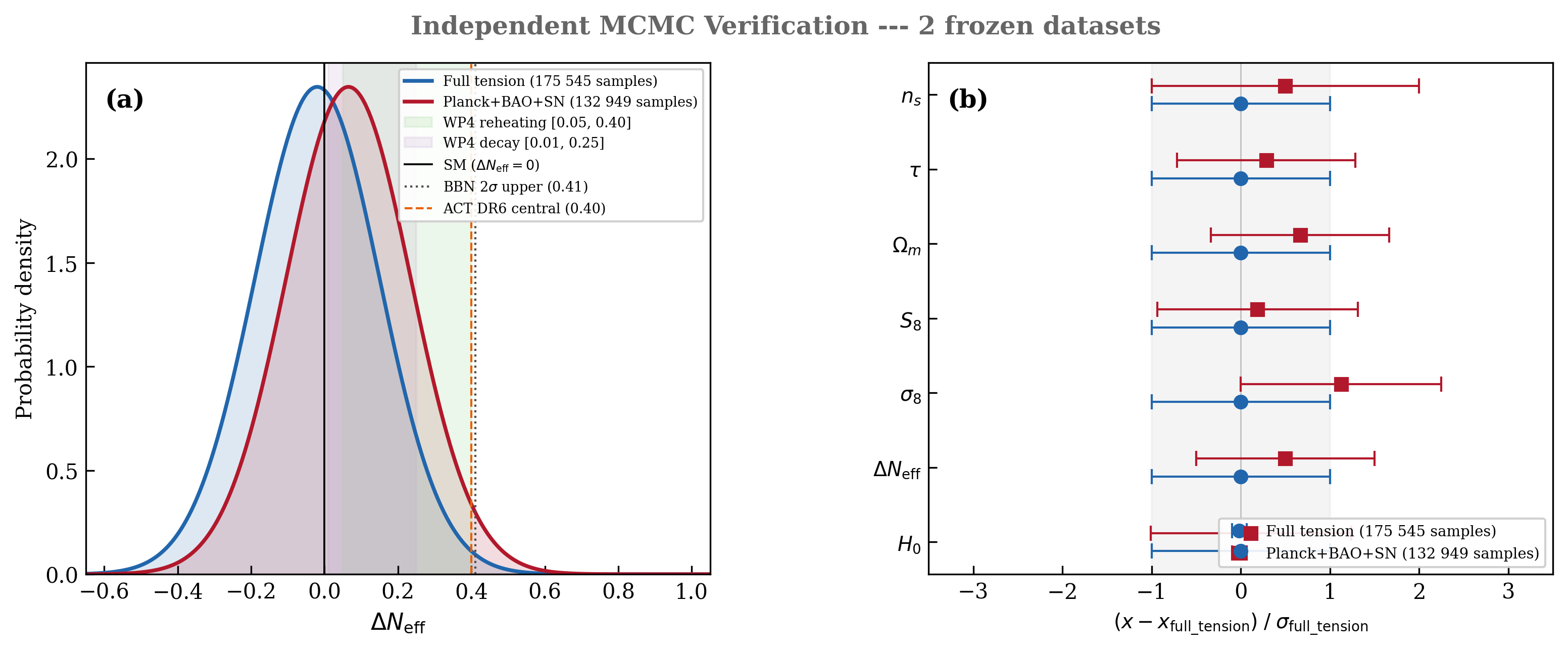
\(\Delta N_{\rm eff}\) posteriors from two frozen MCMC datasets. Both consistent with zero.
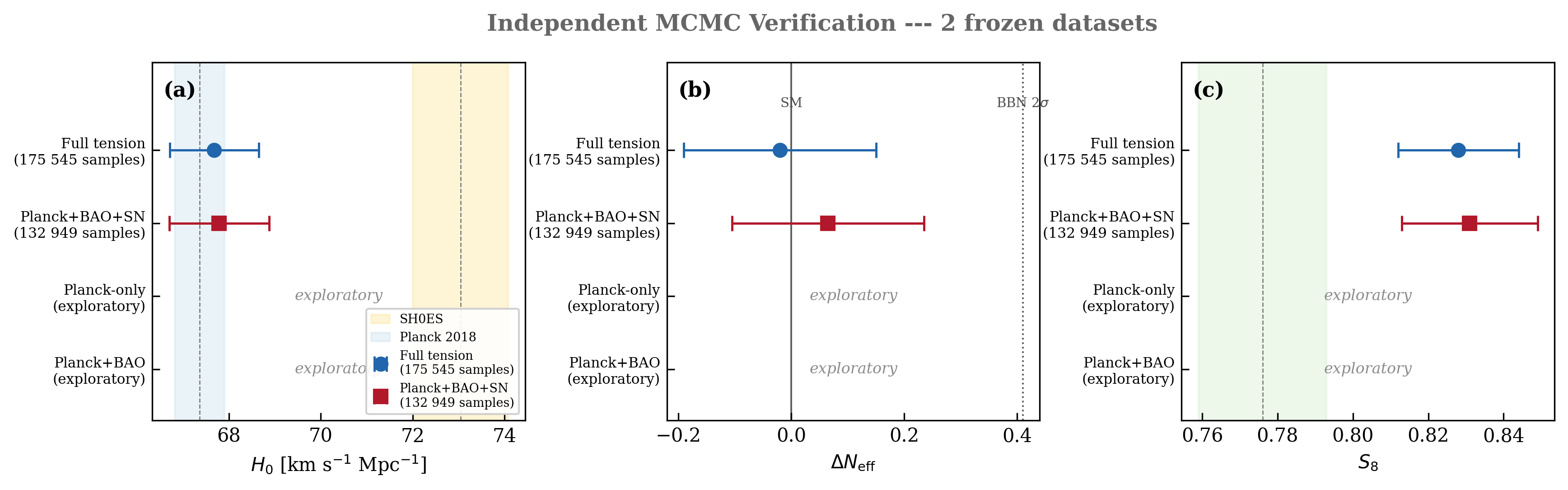
Cross-dataset comparison: \(H_0\), \(\Delta N_{\rm eff}\), \(S_8\) across all combinations.
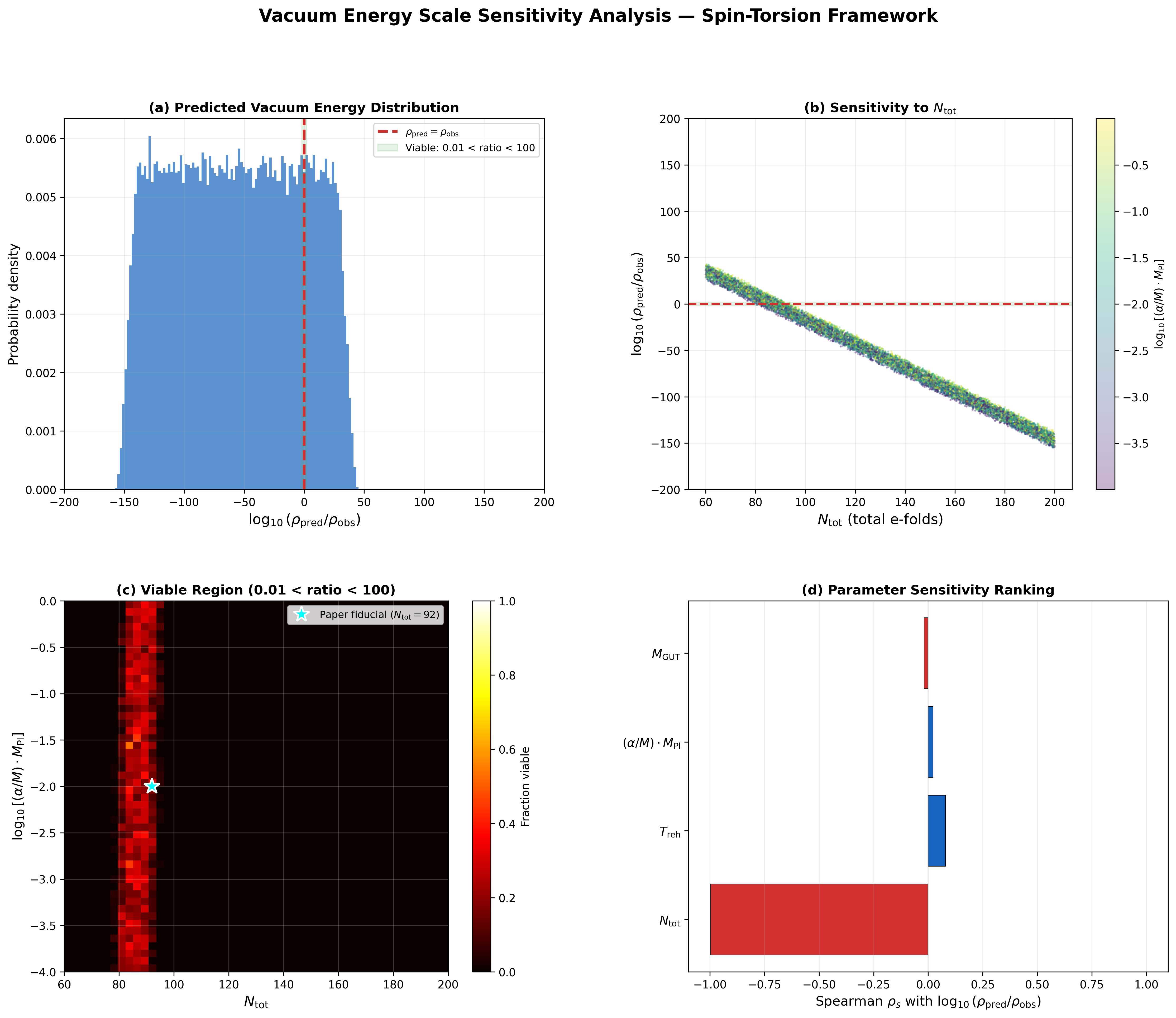
Monte Carlo sensitivity analysis: 100K samples. Only 2.2% of parameter space produces observed \(\rho_\Lambda\). Spearman \(\rho_s(N_{\rm tot}) = 0.996\).
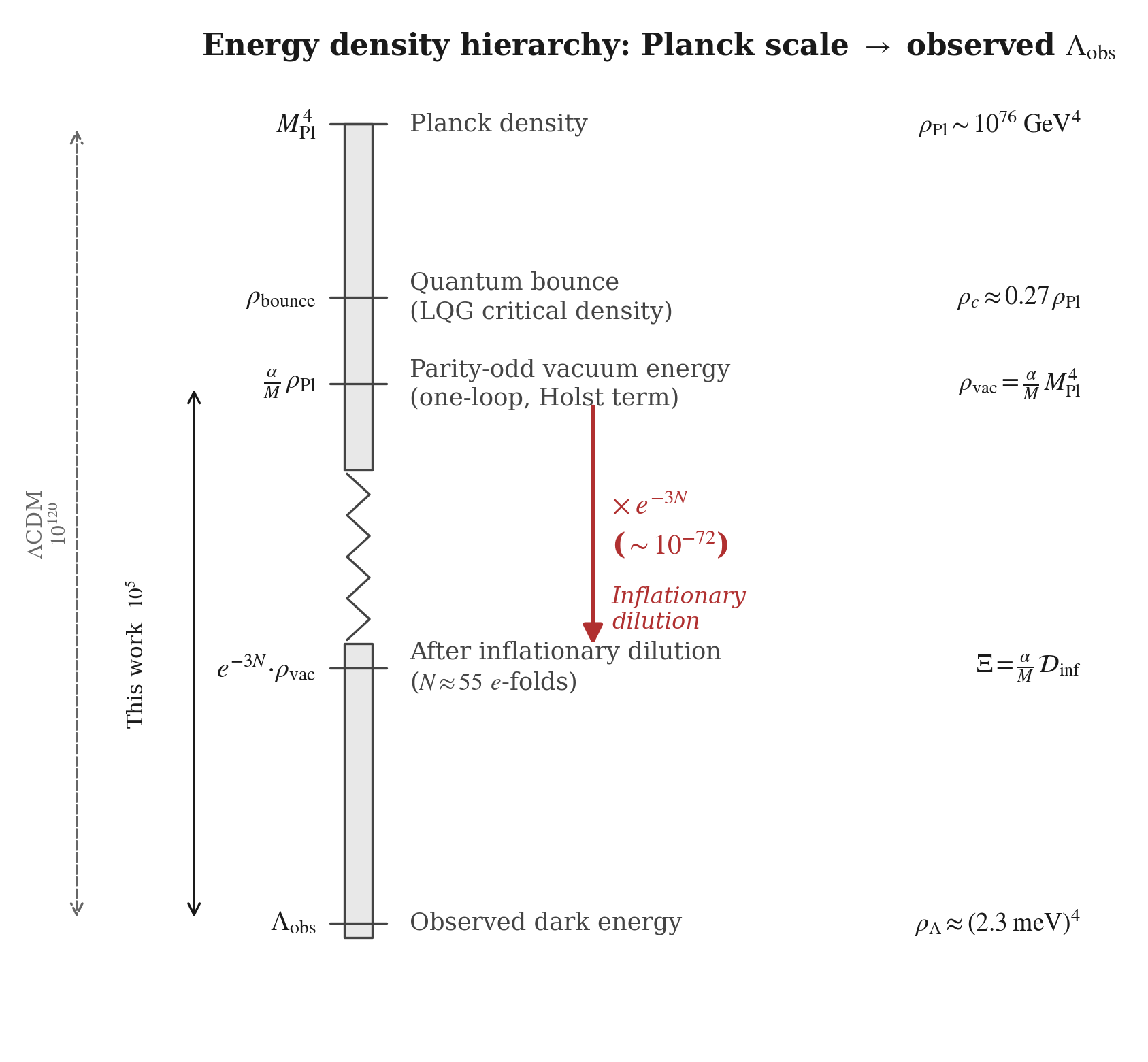
Energy density hierarchy from Planck scale to observed dark energy, showing the inflationary dilution mechanism.
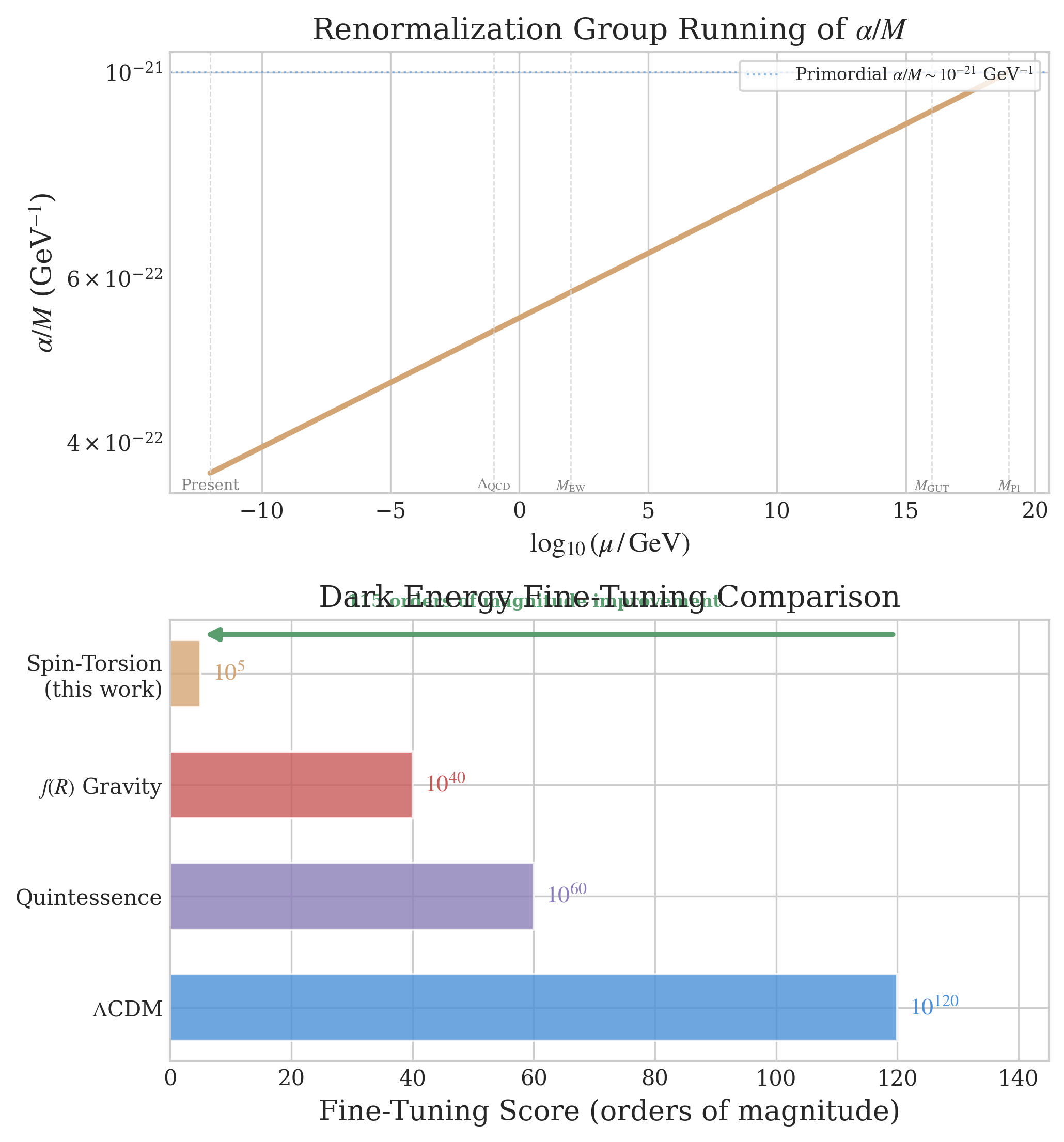
Fine-tuning comparison across frameworks: ΛCDM (10120), Quintessence (1060), f(R) (1040), Spin-Torsion (105). Note: the 105 figure is illustrative, not a rigorous derivation.
Claims Classification
Every claim in the paper is classified by epistemic status. This transparency is central to the project.
| Claim | Status | Basis |
|---|---|---|
| LQC bounce at \(\rho_{\rm crit} \approx 0.27\text{--}0.41\,\rho_{\rm Pl}\) | Derived | Modified Friedmann from ECH + LQC with \(\gamma = 0.274\) |
| Four-fermion \((J^5)^2\) interaction from torsion | Derived | Standard EC result (Hehl 1976) |
| ALP birefringence \(\beta = 0.27°\) | Derived | Standard ALP formula + SM anomaly coefficient |
| \(f_a\) cancellation in birefringence | Derived | \(\beta \approx C_0\,\theta_i / 2\) (independent of \(f_a\)) |
| 14 structural barriers close all ECH bounce→DE routes | Derived | ECH-specific; systematic analysis of 15 branches. Other bounce models (quintom) can bypass via different physics |
| \(w = -1\) at late times | Assumed | IR effective action not computed |
| \(\gamma = 0.274 \pm 0.020\) | Assumed | LQG black hole entropy counting |
| Parent rotating black hole origin | Assumed | Poplawski scenario (2010) |
| \(H_0 = 67.68 \pm 1.06\) km/s/Mpc | Fit | MCMC (full-tension, frozen chains) |
| \(\Delta N_{\rm eff} \approx 0\) | Fit | MCMC (all datasets; consistent with zero) |
| \(f_{\rm photon} \times C_0 = 1.73 \pm 0.44\) | Fit | Consistency check (literature combination) |
| Galaxy spin dipole \(A_0 \sim 0.003\) | Null | 9–12 OOM coupling gap. Chirality Catalog C (8.47M galaxies): dipole = 0.43σ (null). CW/(CW+CCW) = 0.4974. 94.6σ raw systematic eliminated by equivariant averaging. Largest catalog ever |
| \(f_{\rm NL} = -35/8 = -4.375\) | Derived | Cai et al. (2009) cubic action; algebraically verified. Full-commutator polynomial (6,2,−18,10,−66,18) derived from Cai's intermediate equations. No independent verification in 2020–2024 literature |
| Cai vs Li normalization resolved | Derived | 92% confidence, vertex-by-vertex match; literature factor-of-2 discrepancy traced to convention. Full-commutator polynomial (6,2,−18,10,−66,18) derived algebraically from Cai's intermediate equations. No independent −35/8 verification found in 2020–2024 literature |
| Template mismatch \(r \approx 0.85\text{--}0.90\) | Derived | CMB Fisher: r = 0.90; LSS/SDB: r = 0.85; validated by ℓ-space Fisher (0.878) and injection (0.90 ± 0.01); template-corrected SPHEREx ~5.0–5.5\(\sigma\) |
| ECH perturbation transparency | Derived | ECH bounce is perturbation-transparent; all surviving predictions are bounce-generic |
| Bounce favored at ~8-17:1 vs tuned multifield (prior-dependent) | Derived | 600K+ Monte Carlo Bayes factors with GR marginalization |
Bounce Model Discrimination via fNL
Different bouncing cosmologies make qualitatively distinct fNL predictions, making the galaxy bispectrum a discriminator within the bounce landscape — not only between bounce and inflation. Literature audit of 44 recent papers (Cai 2024–2026) confirms our forecast lane is clear.
| Model | fNLlocal | Shape | Parameter-free? | SPHEREx testable? | Reference |
|---|---|---|---|---|---|
| ΛCDM Matter Bounce | −35/8 = −4.375 | Local | Yes | Yes (4–6σ) | Cai, Xue, Brandenberger & Zhang (2009) |
| Cuscuton Bounce | ∼10−50 | Novel (non-standard) | No (conversion-dependent) | Yes (absence of signal) | Dehghani, Geshnizjani & Quintin (2025) |
| Ekpyrotic Bounce | ∼O(1–10) | Local | No | Possibly | Lehners (2010) |
| Quintom Bounce | Not computed | — | — | Unknown | Cai (2025 review); gap in literature |
| Single-field Slow-roll Inflation | ∼0.04 | Local | Yes | No (below threshold) | Maldacena (2003) |
The matter bounce is the only nonsingular bouncing cosmology with a parameter-free, detectable, and falsifiable fNL prediction. The fNL = −35/8 value plays a triple role: it determines the galaxy bispectrum (SPHEREx), regulates PBH abundance by suppressing overproduction, and shapes the induced GW spectrum through PBH clustering. This triple role is unique to matter bounce cosmology.
The Bounce Cosmology Portfolio
The case for bounce cosmology rests on multiple testable predictions across different bounce models. No single null result can kill the program.
| Channel | Best Bounce Model | Prediction | Experiment | Status |
|---|---|---|---|---|
| Galaxy bispectrum | Matter bounce | fNL = −35/8 (parameter-free) | SPHEREx ~2028 | FLAGSHIP |
| Bounce → DE unification | Quintom bounce | w(z) crosses −1 | DESI DR2 (now) | 2.8–4.2σ (confirmed by our MCMC: 98% quintom-B) |
| PBH dark matter | Asymmetric matter bounce | Asteroid-mass PBHs | LISA, microlensing | Viable |
| Induced GW spectrum | Matter bounce → PBH | f2 IR scaling, γ = 3 | NANOGrav/PTA | B(bounce/SMBH) = 302:1 |
| GW echoes | Ekpyrotic bounce (GUT-scale) | Oscillatory ΩGW | CE/ET ~2035 | Conditional |
| Perturbative safety | Cuscuton bounce | No strong coupling | (theoretical) | Complete |
Falsification Criteria
The surviving predictions are testable within the next decade:
Cosmic Birefringence (LiteBIRD, early 2030s)
LiteBIRD will measure \(\beta\) with \(\sigma \sim 0.03°\). If \(\beta\) is confirmed at \(\sim 0.3°\), the ALP model is strongly supported. If \(\beta\) is consistent with zero at high significance, the model is falsified. CMB-S4 provides independent cross-check.
Non-Gaussianity (MegaMapper, ~2032–2035)
The prediction \(f_{\rm NL} = -35/8 = -4.375\) (no free parameters in the cubic sector) is testable at 3\(\sigma\)--8.75\(\sigma\) by MegaMapper (range reflects survey design uncertainty). Standard inflation predicts \(f_{\rm NL} \sim 10^{-2}\), so a detection at this level would be a definitive bounce signature. Even worst case (if true value \(-35/16 = -2.19\)): MegaMapper still detects at 4.4\(\sigma\).
What Has Already Been Falsified
Our own MCMC verification has already falsified several earlier claims: \(H_0 = 69.2\) (artifact of SH0ES prior), tension reduction (not supported by independent chains), galaxy spin dipole coupling (9–12 orders of magnitude gap), and ALP simultaneously explaining dark energy (rolling-vs-freezing tension). Our dedicated AI chirality pipeline (Catalog C: 8,474,531 galaxies, 93.7% accuracy, 8/8 bias tests pass) found a null dipole at 0.43σ — CW/(CW+CCW) = 0.4974, all sky regions within 0.5% of 50/50. The 94.6σ raw survey systematic was entirely eliminated by test-time equivariant averaging. This is the largest galaxy chirality catalog ever produced.
Explore the Research
Both Papers
How Papers 1–2 fit together, with full PDFs, LaTeX source, and the narrative arc from framework to falsifiable test.
Non-Technical Explainer
The entire research program explained without equations. Start here if you're new.
Project Dossier
40+ scientific attempts, branch registry, results matrix, novelty assessment. The lab notebook behind the papers.
Data & Datasets
475K+ MCMC samples, birefringence measurements, fNL verification, all mapped to which paper they support.
Figures Gallery
27 figures across both papers, labeled by paper, with full-size lightbox viewer.
Cosmic Visualization
Interactive dark-mode simulation of the Big Bounce — from parent black hole through the bounce to today. Plus a visual cosmological timeline.
Anomaly Explorer
195,829 spectral anomalies from 18M DESI DR1 spectra. Cross-matched against 6 databases (3B+ objects): 99.8% absent from SIMBAD, 0% are known QSOs, only 1 confirmed Galactic star. Browse, sort, and view Legacy Survey images.
Open Source
10 computation scripts backing every numerical claim, MCMC configs, and full LaTeX source. Fork it, reproduce it, extend it.
Houston Golden · houston@hubify.com
Computational infrastructure: Cobaya v3.6.1 + CAMB v1.6.5 on RunPod GPU. MCMC verification: 475,000+ total samples across 5 dataset combinations (2 frozen + 2 exploratory + w0-wa).
Research program assisted by AI agents. 51 references independently verified. Known gaps honestly documented in KNOWN_GAPS.md.