Explainer · For Students and Curious Minds
Beyond the Singularity: A Student's Guide to the Big Bounce
No physics degree required. An accessible guide to why the universe may not have begun with a "bang" at all — and what torsion, spin, and the Einstein-Cartan-Holst framework have to say about it.
1. The Cosmic Beginning — Bang vs. Bounce
Every cosmology textbook begins with the same dramatic moment: the Big Bang. At time zero, all the matter and energy in the observable universe was compressed into a single point of infinite density and infinite temperature. Space-time itself was crushed into a singularity — a place where the laws of physics, as we understand them, simply break down.
But what if the universe did not begin with a singularity? What if, instead of emerging from a point of infinite density, the universe passed through an extremely dense but finite state — transitioning smoothly from a prior contracting phase into the expanding universe we observe today?
This is the idea behind the Big Bounce.
| The Big Bang | The Big Bounce | |
|---|---|---|
| Starting Point | A singularity — infinite density, zero volume | A finite maximum density — extremely high but not infinite |
| Physics at \(t = 0\) | Breaks down completely — equations give infinities | Remains valid — new physics kicks in to prevent collapse |
| Before the Beginning | Undefined — "there is no before" | A contracting universe that preceded our expanding one |
| Space-Time | Ceases to exist at the singularity | Continuous and smooth through the bounce |
| The Key Question | "What caused the bang?" | "What caused the bounce?" |
The Hourglass Metaphor
Think of the universe like an hourglass. In the Big Bang picture, the sand appears out of nowhere at the narrow waist — there is no top chamber, no prior history. In the Big Bounce picture, sand flows from the top chamber (the contracting universe), passes through the narrow waist (the bounce — the moment of maximum density), and continues into the bottom chamber (our expanding universe). The waist is extremely narrow, but it is not a point of zero size. It is a smooth passage, and the hourglass is a single connected object.
The Big Bounce does not throw out the Big Bang's many successes. The expanding universe, the cosmic microwave background radiation, the formation of light elements in the first few minutes — all of these are preserved. The bounce simply replaces the singular starting point with a smooth transition, and it does so by invoking new physics that becomes important only at the most extreme densities imaginable.
2. Space-Time with a Twist — Introduction to ECH
So what provides the "new physics" that makes the bounce possible? In our research, the answer comes from a framework called Einstein-Cartan-Holst (ECH) gravity. To understand it, we need to think about what space-time is made of.
Beyond Curvature: The Three Pillars of ECH
Einstein's general relativity describes gravity as the curvature of space-time. Massive objects bend the fabric of space-time around them, and this bending is what we experience as gravity. This idea — beautiful, powerful, and confirmed by over a century of experiments — is Pillar 1.
But curvature is not the only way space-time can be deformed. There is another possibility: torsion.
If curvature is the bend of space, torsion is the twist.
Imagine walking along a path on a curved surface (like the surface of a globe). Curvature means that if you walk in a loop and return to your starting point, your direction has rotated. Torsion means something different: if you try to lay down small parallelograms along your path, they do not close up. The space has a built-in twist that prevents them from fitting together perfectly.
Pillar 1: Curvature
The "bend" of space-time. This is Einstein's general relativity — the foundation. Masses curve space, and curved space tells masses how to move.
Pillar 2: Torsion
The "twist" of space-time. In ECH gravity, the intrinsic spin of particles (like electrons and quarks) creates torsion. This is a quantum effect that has no counterpart in classical general relativity.
Pillar 3: The Holst Term
A mathematical ingredient controlled by a number called the Barbero-Immirzi parameter (\(\gamma \approx 0.24\)). This same number appears in loop quantum gravity, connecting our framework to the leading approach to quantum gravity.
The Spin-Torsion Connection
Here is the key idea: every electron, quark, and neutrino in the universe carries a tiny amount of intrinsic angular momentum called spin. In everyday situations, this spin is far too small to have any effect on the geometry of space-time. But in the unimaginably dense conditions near the Big Bang (or Big Bounce), there are so many particles packed so closely together that their collective spin becomes enormous.
In ECH gravity, all this spin generates torsion. And torsion, in turn, creates an effective repulsive force between the particles. The denser the matter gets, the stronger the repulsion. This is the mechanism that prevents the singularity and causes the bounce.
Analogy: The Quantum Spring
Imagine compressing a spring. The more you compress it, the harder it pushes back. In ECH gravity, the "spring" is the spin-torsion interaction. At ordinary densities, the spring is so loose you cannot even feel it. But compress matter to densities approaching the Planck scale (\(\sim 10^{93}\) grams per cubic centimeter — a number so large it defies intuition), and the spring becomes infinitely stiff. The universe bounces.
The mathematical expression for this interaction (for those curious about what it looks like) is:
The four-fermion interaction — spin-torsion coupling
Do not worry about the mathematical details. The important point is that this is not something we added by hand to make the bounce work. It follows automatically from the geometry of ECH gravity. Torsion is a consequence of having both curvature and spin; the repulsive force at high density is a consequence of torsion. The bounce is built into the structure of the theory.
3. The Quantum Trampoline — Torsion-Regulated Bounces
With the spin-torsion mechanism in hand, we can now describe exactly how the bounce works.
The Critical Density
As the universe contracts and the density rises, the spin-torsion repulsion grows. There is a specific density at which the repulsion exactly balances the gravitational attraction, and the contraction stops:
The bounce density — about 27% of the Planck density
The Planck density (\(\rho_{\rm Pl} \approx 5 \times 10^{93}\,\text{g/cm}^3\)) is the natural density scale of quantum gravity. To put this in perspective:
The bounce density is roughly 80 orders of magnitude (a 1 followed by 80 zeros) denser than a neutron star, which is already the densest stable object in the known universe. We are talking about conditions that existed only once — at the bounce itself.
The Modified Friedmann Equation
The equation that governs how the universe expands (or contracts) in standard cosmology is called the Friedmann equation. In our framework, it gets a simple but profound modification:
The modified Friedmann equation
Here, \(H\) is the Hubble parameter — it measures how fast the universe is expanding (positive \(H\)) or contracting (negative \(H\)). In standard cosmology, the factor \((1 - \rho/\rho_{\rm crit})\) is absent, and nothing prevents \(\rho\) from growing without limit.
With the correction factor:
- When \(\rho\) is small compared to \(\rho_{\rm crit}\), the correction is negligible, and the universe behaves exactly as Einstein predicted.
- When \(\rho\) approaches \(\rho_{\rm crit}\), the factor \((1 - \rho/\rho_{\rm crit})\) approaches zero, forcing \(H \to 0\). The expansion (or contraction) slows to a halt.
- At \(\rho = \rho_{\rm crit}\), we have \(H = 0\) exactly — the universe is momentarily still. This is the bounce.
Teacher's Insight: Torsion as a "Quantum Brake"
You can think of torsion as a quantum brake built into the fabric of space-time. Under normal conditions, the brake is completely disengaged — you would never know it was there. But as the universe collapses toward what would have been a singularity, the brake engages progressively. At the critical density, the brake locks completely, the collapse halts, and the universe rebounds. No singularity, no breakdown of physics, no infinities. Just a smooth, if spectacularly violent, U-turn.
4. The Mystery of Dark Energy — A Geometric Solution?
One of the great mysteries of modern cosmology is dark energy — the unknown force driving the accelerating expansion of the universe. Dark energy makes up about 68% of the total energy content of the cosmos, yet we have no fundamental understanding of what it is.
A natural question to ask is: could the same spin-torsion physics that produces the bounce also explain dark energy? After all, if torsion modifies gravity at high densities, perhaps it also modifies gravity at low densities in a way that looks like dark energy.
This was one of the central questions of the BigBounce research program. And the answer, arrived at after exhaustive investigation, is:
The Honest Answer: No — And That Is a Valuable Result
Thirteen distinct structural barriers prevent the ECH bounce from generating dark energy through any of the standard mechanism classes we explored. Every minimal route was closed by a rigorous no-go argument. The bounce operates at energy scales roughly 120 orders of magnitude higher than dark energy, and there is no known mechanism to bridge that gap within the ECH framework.
This might sound like a failure, but in science, definitively closing off incorrect paths is just as important as finding correct ones. Future researchers now know exactly which approaches do not work and why, potentially saving years of effort.
The Scale Gap
To understand why connecting the bounce to dark energy is so difficult, consider the energy scales involved:
The gap between the bounce scale and the dark energy scale spans roughly 9 to 12 orders of magnitude even in the most optimistic framing, and up to 120 orders of magnitude in the most direct comparison. No known symmetry or mechanism can naturally bridge such an enormous hierarchy.
"We have successfully mapped the dead-end paths. The 14 barriers are a map of the territory — not a map of failure, but a map of understanding."
5. Testing the Blueprint — Observations and Evidence
Science is ultimately about predictions that can be tested. Despite the closure of the dark energy connection, the ECH framework makes several concrete predictions that are being tested by real experiments right now.
Prediction 1: Cosmic Birefringence
What Is Birefringence?
When light passes through certain crystals (like calcite), its polarization direction rotates. This is called birefringence. Remarkably, a similar effect can happen to light traveling through the cosmos — if there is a suitable particle (called an axion-like particle, or ALP) permeating all of space.
The ECH framework motivates the existence of such a particle and predicts a specific rotation angle for the polarization of the cosmic microwave background (the afterglow of the Big Bang/Bounce):
Our Prediction
Observed Value
Our prediction of \(0.27^\circ\) sits comfortably within the error bars of the observed value of \(0.35 \pm 0.09^\circ\). The discrepancy is less than \(1\sigma\) — well within the range that could be explained by measurement uncertainty alone. The upcoming LiteBIRD satellite (launching in the late 2020s) will measure this angle with much greater precision, providing a definitive test.
Prediction 2: The Hubble Tension Reality Check
What Is the Hubble Tension?
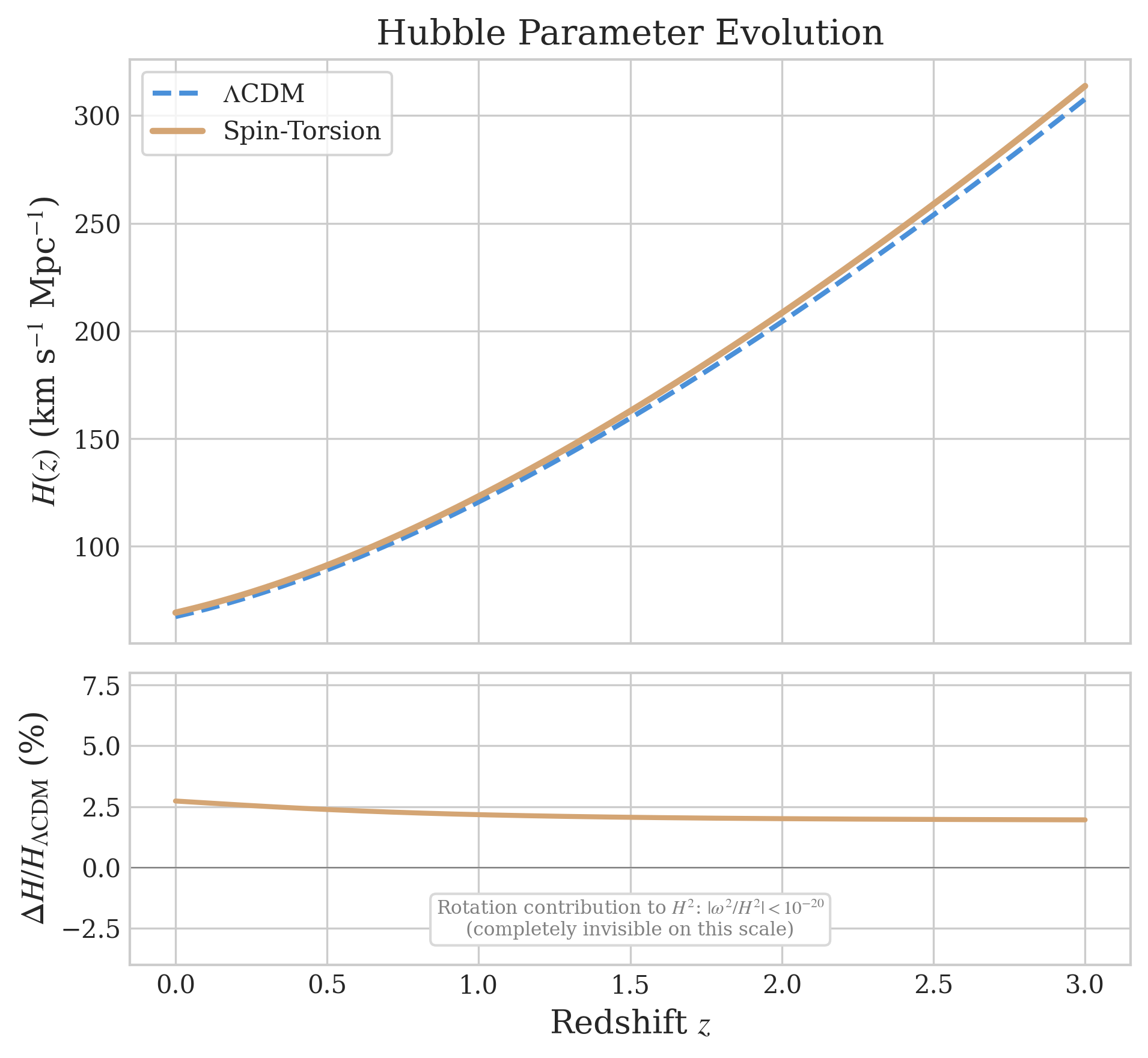
Different methods of measuring the expansion rate of the universe give different answers. Measurements from the early universe (using the cosmic microwave background) give \(H_0 \approx 67.4\) km/s/Mpc, while measurements from the nearby universe (using supernovae and other distance indicators) give \(H_0 \approx 73\) km/s/Mpc. This \(\sim 5\sigma\) discrepancy is called the "Hubble tension" and is one of the biggest puzzles in modern cosmology.
Our MCMC (Markov Chain Monte Carlo) analysis, fitting the ECH model to Planck data, yields:
ECH framework fit to Planck CMB data
This matches the standard cosmological model (\(\Lambda\)CDM) value to high precision. It means the ECH framework does not resolve the Hubble tension — but it also does not make it worse. The framework is fully compatible with existing precision cosmological data.
Prediction 3: The Matter-Bounce Non-Gaussianity
The Flagship Prediction
The most exciting prediction comes from the matter-bounce scenario (Branch V of our research program). If the universe contracted through a matter-dominated phase before bouncing, the primordial density fluctuations should carry a specific statistical signature called non-Gaussianity:
This number is not adjustable. It falls directly out of the physics of the contraction, with no free parameters to tune. The NASA SPHEREx mission will be able to detect this signal at \(2.5\sigma\) significance — a strong hint, though not yet a definitive discovery.
What makes this prediction special is that standard inflationary models predict a much smaller value (\(f_{NL} \sim 0.01\)). A detection of \(f_{NL} \approx 0.4\) would be powerful evidence that the universe bounced rather than inflated.
6. The Big Picture — Why This Matters
The BigBounce research program is, at its core, an honest exploration of a fundamental question: can the geometry of space-time, extended to include torsion and spin, explain the deepest puzzles of cosmology?
The answer is nuanced:
- The singularity problem: Yes. The ECH framework resolves the Big Bang singularity through a torsion-regulated bounce. This is a robust result that follows from the structure of the theory.
- Dark energy: No. Thirteen barriers close all standard routes. The bounce and dark energy are independent problems.
- Observable predictions: Two survive. The matter-bounce non-Gaussianity (\(f_{NL} = -35/8\)) and the ALP birefringence (\(\beta = 0.27^\circ\)) are concrete, testable predictions with active experimental programs targeting them.
- The value of negative results: Immense. The 14 barriers constitute a systematic map of what the framework cannot do, guiding future research away from dead ends.
What Comes Next
Next Steps for the Research Program
The LiteBIRD satellite will measure cosmic birefringence with unprecedented precision. A confirmation of \(\beta \approx 0.27^\circ\) would validate a key prediction of the framework.
The Phase 1 calculation for Branch V — propagating perturbations through the explicit ECH bounce — is the highest-priority theoretical task. It will confirm whether \(f_{NL} = -35/8\) holds in the full ECH framework.
The SPHEREx mission will constrain \(f_{NL}\) at the level needed to test the matter-bounce prediction. Having the theoretical calculation complete before the data arrives is essential.
Some of the 14 barriers may have loopholes that become apparent with new mathematical tools or physical insights. The barrier map is a living document, not a final verdict.
A Final Thought
The universe does not need to begin with a scream of nothingness. It may instead have passed, with quantum grace, through the eye of a needle — a moment of unimaginable density where the twist of space-time itself provided the trampoline for everything that followed. Whether this picture is correct is now a question for the observatories, the satellites, and the data. The mathematics is ready. The predictions are on the table. Nature will have the last word.
Glossary of Key Terms
For quick reference, here are the important concepts introduced in this article:
| Term | Meaning |
|---|---|
| Big Bounce | The idea that the universe transitioned from contraction to expansion through a finite-density state, avoiding the Big Bang singularity. |
| Torsion | The "twist" of space-time geometry, caused by the spin of particles. Absent in standard general relativity, present in ECH gravity. |
| ECH Gravity | Einstein-Cartan-Holst gravity — an extension of general relativity that includes both curvature and torsion, connected to loop quantum gravity. |
| Barbero-Immirzi Parameter (\(\gamma\)) | A fundamental constant (\(\approx 0.24\)) that appears in both the ECH action and the area spectrum of loop quantum gravity. |
| Critical Density (\(\rho_{\rm crit}\)) | The maximum density the universe can reach before the bounce occurs. About 27% of the Planck density. |
| Non-Gaussianity (\(f_{NL}\)) | A statistical measure of how the primordial density fluctuations deviate from a perfectly Gaussian (bell-curve) distribution. |
| Birefringence (\(\beta\)) | A rotation of the polarization angle of light as it travels through the cosmos, caused by interaction with an axion-like particle. |
| SPHEREx | A NASA space telescope that will map hundreds of millions of galaxies to constrain primordial non-Gaussianity. |
| LiteBIRD | A JAXA satellite that will measure CMB polarization with unprecedented precision, testing the birefringence prediction. |
| Hubble Parameter (\(H_0\)) | The current rate of expansion of the universe, measured in km/s/Mpc. |
| Dark Energy | The unknown energy component driving the accelerated expansion of the universe. About 68% of the total energy content. |