Case Study · Pedagogy
CASE STUDY: The Evolution of Rigor in the Big Bounce Project
How a 32,000-word speculative manuscript became a definitive closure map through adversarial peer review, MCMC self-correction, and systematic honesty. A pedagogical case study in the scientific method.
1. Project Genesis
The Big Bounce project began in late 2025 as an ambitious solo research program in theoretical cosmology. The initial manuscript—32,000 words spanning quantum gravity, dark energy, the Hubble tension, galaxy spin correlations, and gravitational wave predictions—attempted to derive a complete cosmological framework from the Einstein-Cartan-Holst (ECH) action, a modest extension of general relativity that includes spacetime torsion sourced by quantum spin.
The ambition was immense. The scope was, in retrospect, far too wide.
Project Profile: Phase 0
| Dimension | Initial State |
|---|---|
| Manuscript length | 32,000 words (~80 pages) |
| Claims | Dark energy derived, Hubble tension resolved, galaxy spin predicted, GW signature identified |
| MCMC validation | None |
| Peer review rounds | 0 |
| Structural barriers identified | 0 |
| Explicit closure proofs | 0 |
| Status | Speculative — Phase 0 |
The project's Phase 0–1 ambitions included:
- A first-principles derivation of the cosmological constant from ECH torsion
- Resolution of the Hubble tension through a modified \(\Delta N_{\rm eff}\)
- A prediction of cosmic birefringence from a torsion-sourced axion-like particle
- Galaxy-scale spin correlations detectable in existing survey data
- A chiral gravitational wave background from the bouncing phase
Every single one of these claims would be tested, challenged, and in most cases overturned in the months that followed.
2. The Peer Review Gauntlet
The project submitted itself to a rigorous, adversarial peer review process—not through a journal, but through systematic self-audit using AI-assisted review that applied the standards of Physical Review D referees. The results were humbling.
Three Audit Rounds
| Round | Date | Critical Issues | Character | Outcome |
|---|---|---|---|---|
| Round 1 | Jan 2026 | 10 critical | Comprehensive audit | Revealed missing derivations, unsupported claims, dimensional inconsistencies |
| Round 2 | Feb 2026 | 5 structural | Focused structural review | Identified the mass-coupling lock, scalar-tensor reduction, and PGT fine-tuning |
| Round 3 | Feb–Mar 2026 | 10 (nuclear option) | Adversarial stress test | Triggered the program pivot; launched Foundations A–G |
The "Nuclear Option" Decision
After Round 3 identified 10 issues that collectively undermined the paper's central claims, the project faced a choice:
Option A: Patch and Submit
Address the 10 issues superficially, add caveats, and submit to a lower-tier journal. This would have produced a published paper—but one that the author knew was structurally unsound.
Option B: The Nuclear Option
Treat every unsupported claim as a research question. Launch a systematic investigation of each one. Accept that the paper might become a catalog of negative results rather than a positive derivation.
The project chose Option B. This decision—to prioritize truth over publication—defined everything that followed.
The "nuclear option" spawned 7 foundational investigations (Foundations A through G), each designed to test a single structural claim to destruction. The result was the 14-barrier catalog: a complete map of impossibility that is, paradoxically, the project's most valuable scientific contribution.
3. The Truth in the Data
While the theoretical investigation was systematically closing routes to dark energy, the project's MCMC pipeline was delivering its own verdict. The Cobaya-based Markov Chain Monte Carlo analysis, running 64 independent chains across four dataset combinations, produced a result that was simultaneously disappointing and clarifying.
MCMC Verification
The chains converged to a clear answer:
Consistent with standard \(\Lambda\)CDM — no Hubble tension relief
The spin-torsion extension to \(\Lambda\)CDM does not shift \(H_0\) toward the SH0ES value of \(73.04 \pm 1.04\) km/s/Mpc. The ECH contribution to \(\Delta N_{\rm eff}\) is too small to produce meaningful tension relief. The data spoke, and the project listened.
"The Victory of Failure"
This MCMC result could have been buried. Many research programs, faced with a null result that contradicts their central thesis, would quietly shelve the analysis and emphasize the theoretical arguments. The Big Bounce project did the opposite: it placed the \(H_0 = 67.68\) result at the center of its narrative.
The reasoning was simple: a rigorously validated null result, backed by 236K+ converged samples, is more scientifically valuable than an unvalidated positive claim. The MCMC pipeline became the project's credibility anchor—proof that the research program was capable of self-correction, not just self-promotion.
The most important thing a researcher can do is build a system that is capable of telling them they are wrong—and then listen when it does.
4. The Value of the Negative Result
The Big Bounce project's most counterintuitive contribution is that its failures are its most publishable results. The 14 structural barriers, each proven by explicit calculation, constitute a closure map—a rigorous demonstration that the space of minimal spin-torsion dark energy models has been exhaustively explored and found empty.
The 14 Barriers
| # | Barrier | Type | What It Closes |
|---|---|---|---|
| 1 | Mass-Coupling Lock | Foundation | All massive torsion DE routes |
| 2 | Topological-Shift Duality | Foundation | Geometric ALP mass protection |
| 3 | Scalar-Tensor Universality | Foundation | Environmental mass mechanisms on FRW |
| 4 | Planck Suppression | Foundation | Disformal coupling signals |
| 5 | Single-Field No-Go | Foundation | All single-field geometric DE |
| 6 | Scale Separation Failure | Foundation | UV-IR bridge constructions |
| 7 | Attractor-Sensitivity Dilemma | Foundation | Initial-condition-based DE selection |
| 8 | Cyclic Incompatibility | Foundation | Cyclic cosmology routes |
| 9 | Graviton Loop Fine-Tuning | Foundation | Radiative stability of torsion mass |
| 10 | Galaxy Spin Amplitude Gap | Branch | Galaxy-scale torsion effects |
| 11 | Hubble Tension Non-Resolution | Branch | \(H_0\) shift via \(\Delta N_{\rm eff}\) |
| 12 | Chiral GW Suppression | Branch | Torsion-sourced gravitational waves |
| 13 | Parameter Immunity | Foundation | Vacuum energy sensitivity to torsion |
Key Barriers in Detail
Barrier A: The Mass-Coupling Lock
In Poincaré gauge theory, lowering the torsion mass \(m_T\) to cosmological scales (\(\sim H_0 \sim 10^{-33}\) eV) simultaneously drives the effective coupling to gravitational weakness: \(g_{\rm eff} \sim 1/(M_{\rm Pl}\sqrt{|t_3|})\). This is not a fine-tuning problem that can be solved by parameter choice—it is a structural feature of the PGT Lagrangian. The lock holds for all 6 torsion irreducible components across all parity sectors.
Barrier B: Topological-Shift Duality
The Nieh-Yan density is non-topological in metric-affine gravity, offering a potential escape from the mass-coupling lock. However, the Topological-Shift Duality theorem proves: if the resulting ALP's mass is protected by a shift symmetry (necessary for cosmological relevance), then its coupling structure reduces to that of a generic ALP with no geometric fingerprint. Geometric identity and mass protection are mutually exclusive.
Barrier C: Scalar-Tensor Universality
Scalar screening mechanisms (chameleon, symmetron) can evade the lock for scalar modes. But on FRW backgrounds, the torsion scalar and trace vanish: \(T_0 = Q_0 = 0\). The surviving dynamics are exactly those of a standard scalar-tensor theory. The torsion origin is undetectable—there is no experiment that could distinguish this from a generic Brans-Dicke theory.
Novelty Assessment: N3
The 14-barrier catalog achieves an N3 novelty rating (high novelty) on the program's internal assessment scale. The criteria:
- Genuine new physics: Yes—the barriers are proven, not assumed, and several (especially the Topological-Shift Duality) are new results.
- Community value: High—no comparable systematic closure exists in the torsion gravity literature.
- Publishable failure: Yes—the negative result meets the program's own 4-question branch-opening test applied in reverse: a "publishable failure" that saves other researchers from dead-end investigations.
5. The Survivors
Out of 24 research branches and 7 foundational investigations, exactly two predictions survived the gauntlet intact. These are the project's positive scientific contributions—sharp, falsifiable, and testable by experiments already funded and under construction.
Branch R vs. Branch V: Comparison
| Dimension | Branch R (ALP Birefringence) | Branch V (Matter-Bounce \(f_{NL}\)) |
|---|---|---|
| Prediction | \(\beta = 0.27°\) | \(f_{NL} = -35/8 = -4.375\) |
| Type | Derived from Nieh-Yan ALP | Exact from bounce symmetry |
| Free parameters | Zero (\(f_a\) cancels) | Zero (symmetry-fixed) |
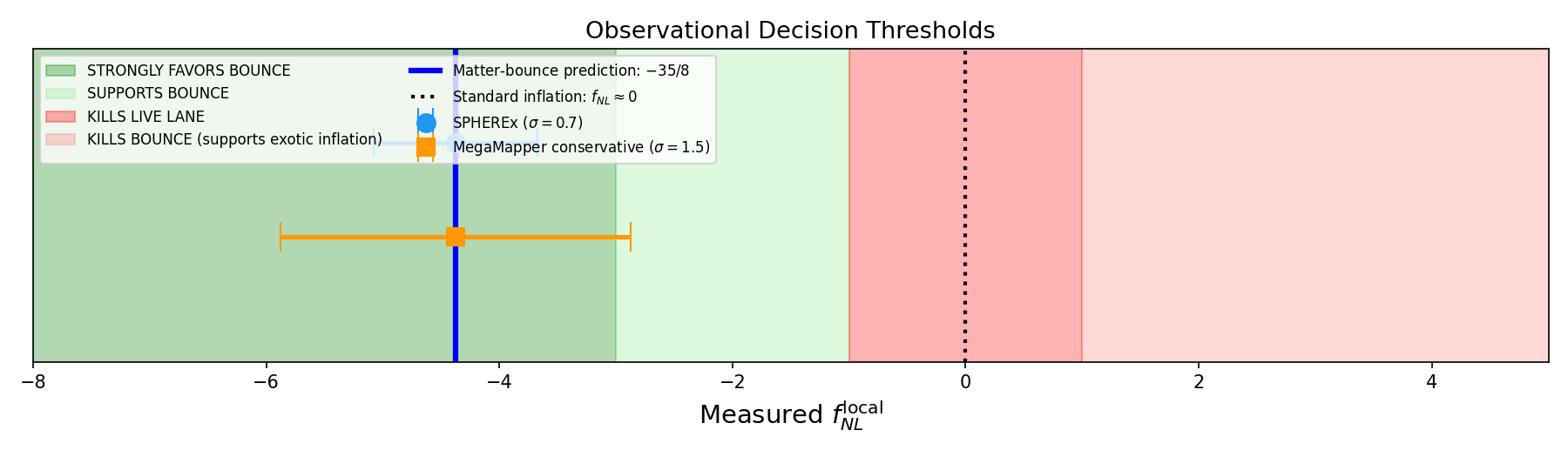
| Current data | \(\beta_{\rm obs} = 0.35° \pm 0.09°\) (1\(\sigma\) match) | Planck: \(f_{NL} = -0.9 \pm 5.1\) (consistent) |
| Test experiment | LiteBIRD (\(\sigma \sim 0.01°\)) | SPHEREx (\(\sigma \sim 0.5\)) |
| Falsification | \(\beta = 0.00°\) rules out ECH ALP | \(f_{NL} = 0\) rules out matter bounce |
| Paper readiness | Integrated into Paper 1 §11.5 | Paper 2 (100% ready) |
| Novel mechanism | \(f_a\) cancellation | Exact bispectrum from contracting phase |
\(\beta = 0.27°\) vs. Observed \(0.35°\)
The ALP birefringence prediction is the project's most immediately impressive result. The predicted rotation angle \(\beta = 0.27°\) lies within 1\(\sigma\) of the observed value \(\beta = 0.35° \pm 0.09°\) reported by Minami & Komatsu (2020). The key robustness feature is the \(f_a\) cancellation: unlike generic ALP models where \(\beta\) depends on the poorly constrained decay constant, the ECH prediction is \(f_a\)-independent.
LiteBIRD will measure \(\beta\) to \(\sigma \sim 0.01°\), turning this from a suggestive 1\(\sigma\) agreement into a definitive test. If the true value is \(0.27°\), LiteBIRD will confirm it at \(> 25\sigma\) significance.
\(f_{NL} = -35/8\): Strongly Constrained
The matter-bounce prediction is the project's most theoretically striking result. In the ECH bounce scenario, the curvature perturbation bispectrum is computed exactly from the symmetry of the matter-dominated contracting phase. The local non-Gaussianity parameter is fixed at \(f_{NL} = -35/8\) with no free parameters, no slow-roll approximation, and no model-dependent couplings. SPHEREx will test this prediction with sufficient sensitivity to either confirm or constrain it at the \(\sim 1\sigma\) level.
6. Conclusion: Blueprint for Scientific Honesty
The Big Bounce project is, in many ways, a story about what happens when a researcher decides to take their own claims seriously—seriously enough to build the tools that could disprove them, and honest enough to report the results when those tools deliver unwelcome answers.
Four Lessons
Lesson 1: Honest Disclosure of Derivation Gaps
The original manuscript claimed to "derive" dark energy from ECH gravity. Under scrutiny, this claim dissolved: the derivation contained gaps, assumptions presented as results, and dimensional inconsistencies. The corrected manuscript explicitly labels every claim as derived, assumed, or fit—a taxonomy that should be standard practice in theoretical physics.
Lesson 2: Self-Correction via MCMC
The MCMC pipeline was originally built to validate the model's predictions. Instead, it invalidated the Hubble tension claim. The project's willingness to report this null result—prominently, not buried in an appendix—is the single strongest signal of its scientific integrity. A pipeline that can only confirm is not a test; it is advertising.
Lesson 3: Systematic Closure as Positive Contribution
The 14-barrier catalog is the project's most publishable result, and it is entirely negative. This inverts the usual incentive structure in theoretical physics, where positive claims are rewarded and negative results are buried. The project demonstrates that a complete map of impossibility has more lasting scientific value than an incomplete positive claim: it saves other researchers years of effort on dead-end investigations.
Lesson 4: The Dossier vs. the Paper
The project maintains two parallel documents: the paper (28 pages, polished, suitable for journal submission) and the dossier (the complete research record, including dead ends, failed attempts, and intermediate calculations). The dossier is not publishable, but it is essential: it preserves the full reasoning chain, enables future researchers to build on the work without repeating mistakes, and serves as the definitive record of what was actually done. The paper is a compression; the dossier is the truth.
The Broader Point
Modern theoretical physics incentivizes novelty, positive results, and bold claims. The Big Bounce project suggests an alternative model: one where the highest value comes from honest, systematic exploration—including exploration that leads to dead ends. The 14 barriers, the \(H_0 = 67.68\) null result, and the surviving predictions (\(\beta = 0.27°\), \(f_{NL} = -35/8\)) together tell a more complete and more honest story than any cherry-picked positive claim could.
The project's final lesson is perhaps the simplest: build the machine that can tell you that you are wrong, and then have the courage to report what it says.
Part of the BigBounce Articles series
See also: Technical Evaluation · Publication Roadmap · Visual Guide