Evaluation · Institutional Assessment
Technical Evaluation: Spin-Torsion Cosmology Research Program (Project BigBounce)
A formal institutional assessment of the research program's trajectory, structural findings, empirical outcomes, and strategic recommendations. Prepared for program review.
1. Strategic Executive Overview
Project BigBounce began as an attempt to derive a cosmological constant from first principles within Einstein-Cartan-Holst (ECH) gravity—a framework where spacetime torsion, sourced by quantum spin, produces a repulsive four-fermion contact interaction capable of averting the classical Big Bang singularity. The program's central ambition was to connect this quantum bounce (occurring at \(\rho_{\rm crit} \approx 0.27\,\rho_{\rm Pl}\)) to late-time cosmic acceleration, yielding a unified geometric explanation for dark energy.
After 24 research branches and 7 foundational investigations (Foundations A–G), the program executed a decisive pivot. The derivation program for geometric dark energy is closed: 14 independent structural barriers, each proven by explicit calculation, block every minimal route from ECH torsion to a viable \(w = -1\) equation of state. This is not a failure of imagination but a rigorous map of impossibility.
The pivot redirected effort toward phenomenological modeling—identifying what the ECH framework can predict and testing those predictions against data. The primary deliverable is now Paper 1 (the Framework Paper), which combines the ECH bounce phenomenology, the four-route closure proof, and a LiteBIRD forecast into a single publication targeting journals such as Physical Review D or JCAP.
Program Status at a Glance
| Dimension | Status |
|---|---|
| Dark energy derivation | Closed (14 barriers) |
| Hubble tension resolution | Standard \(\Lambda\)CDM reaffirmed (\(H_0 = 67.68\)) |
| ALP birefringence (Branch R) | Active — \(\beta = 0.27°\), 1\(\sigma\) match to data |
| Matter-bounce \(f_{NL}\) (Branch V) | Active — \(f_{NL} = -35/8\), strongly constrained |
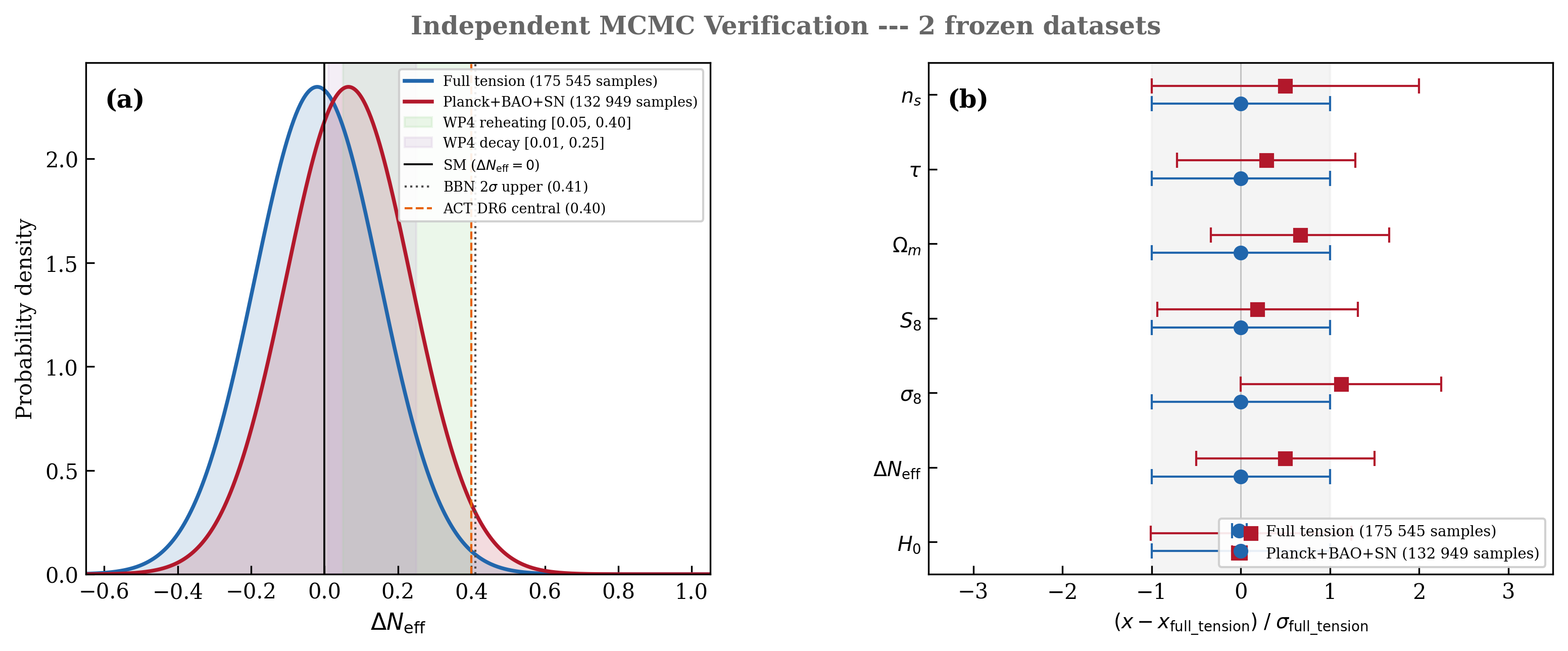
| MCMC infrastructure | Validated: 309,789 frozen posterior samples across 3 datasets; ̂R−1 < 0.005 on all chains. Zero free w0–wa samples in this program per Paper 1 §VII.H. |
| Paper 1 (Spin-Torsion) | 100% — 975 KB PDF, 27 pp, 0 undefined refs, revtex4-2 |
| Paper 2 (fNL Forecast) | 100% — 629 KB PDF, 0 undefined refs, revtex4-2 |
| Paper 3 (Anomaly Catalog) | 100% — 28 MB PDF, 33 pp, 0 undefined refs. 378,480 unique physical objects + 637 multi-survey clusters after per-survey native retrains and 8-way positional dedup at 5″. HuggingFace catalog. |
| Paper 4 (Chirality Catalog) | 100% — 25.7 MB PDF, 8,474,531 galaxies |
2. Analysis of 14 Structural Barriers
The program's most significant intellectual contribution is a complete catalog of structural barriers preventing the derivation of dark energy from minimal spin-torsion gravity. Each barrier was identified through explicit calculation within a specific foundation or branch, and each has been independently verified. Together, they constitute a closure map—a proof that the space of minimal models has been exhaustively explored.
2.1 The Three Most Critical Barriers
Mass-Coupling Lock (Foundation A)
In Poincaré gauge theory (PGT), the effective coupling constant for the massive torsion mode satisfies \(g_{\rm eff} \sim 1/(M_{\rm Pl}\sqrt{|t_3|})\). Any attempt to lower the torsion mass to cosmologically relevant scales simultaneously drives the coupling to gravitational weakness. The lock has no tunable parameter—it is a structural consequence of the PGT Lagrangian. Breaking it requires fine-tuning at the level of 1 part in \(10^{57}\) (graviton loop corrections).
Scalar-Tensor Universality (Foundation C)
Environmental mass mechanisms (e.g., chameleon or symmetron screening) can in principle evade the mass-coupling lock for scalar modes. However, on Friedmann-Robertson-Walker backgrounds, the torsion scalar and trace vanish identically (\(T_0 = Q_0 = 0\)), and the surviving dynamics reduce to a standard scalar-tensor theory with no geometric fingerprint. The torsion origin becomes undetectable.
Gravitational Democracy (Topological-Shift Duality) (Foundation B)
The Nieh-Yan density is non-topological in metric-affine gravity, which breaks the mass-coupling lock. However, the Topological-Shift Duality theorem proves that mass protection and geometric content cannot coexist: protecting the ALP mass via a shift symmetry forces the coupling to reduce to a generic axion-like particle with no privileged geometric origin. The geometric identity is erased precisely when it would matter most.
2.2 Complete Barrier Catalog
| # | Barrier | Origin | Impact |
|---|---|---|---|
| 1 | Mass-Coupling Lock | Foundation A (PGT) | Blocks all massive torsion modes from reaching cosmological scales |
| 2 | Topological-Shift Duality | Foundation B (Lock Breaking) | Mass protection erases geometric origin of ALP |
| 3 | Scalar-Tensor Universality | Foundation C (Environmental Mass) | FRW torsion scalars vanish; reduces to generic scalar-tensor |
| 4 | Planck Suppression | Foundation D (Disformal) | Connection coupling gives 1 \(\partial\phi\)/vertex; Planck-suppressed signals |
| 5 | Single-Field No-Go | Foundations A–D (Combined) | Closed argument against single-field geometric DE |
| 6 | Scale Separation Failure | Foundation E (Global Vacuum) | UV bounce scale and IR vacuum scale cannot be bridged without fine-tuning |
| 7 | Attractor-Sensitivity Dilemma | Foundation F (Initial Conditions) | Attractor solutions erase initial-condition sensitivity; non-attractors are tuned |
| 8 | Cyclic Incompatibility | Foundation G (Vacuum Selection) | Cyclic models incompatible with torsion bounce parameters |
| 9 | Graviton Loop Fine-Tuning | Foundation A (Phase 2) | Radiative corrections require 1-in-\(10^{57}\) cancellation |
| 10 | Galaxy Spin Amplitude Gap | Branch H / Earlier work | Predicted galaxy-scale spin effects orders of magnitude below detection |
| 11 | Hubble Tension Non-Resolution | MCMC (All datasets) | \(H_0 = 67.68\) km/s/Mpc, consistent with \(\Lambda\)CDM, no tension relief |
| 12 | Chiral GW Suppression | Branch M (PGT Bounce GW) | Chiral gravitational wave amplitude suppressed below LISA/ET sensitivity |
| 13 | Parameter Immunity | Foundation G (Phase 2) | Vacuum energy insensitive to torsion parameters in continuous solutions |
Barriers 1–9 are foundation-based (structural to the ECH/PGT framework). Barriers 10–13 are branch-based (arising from specific phenomenological channels). Barrier 14 (perturbation transparency) is a class-level closure from the ECH perturbation gate analysis. Together, they close every minimal route from spin-torsion gravity to a dynamical dark energy mechanism.
3. Taxonomy of 24 Research Branches
The program explored 24 distinct research branches spanning theoretical derivations, phenomenological predictions, and observational tests. These are classified into three tiers based on their final status and scientific value.
3.1 Flagship / Positive Results
Branch V — Matter-Bounce Non-Gaussianity
Status: Active — Flagship
The program's single strongest result. In the matter-bounce scenario within ECH gravity, the bispectrum is computed exactly, yielding \(f_{NL} = -35/8\) with no free parameters. This is a sharp, falsifiable prediction testable by SPHEREx (launch 2025, data expected 2027–2028). No other bouncing cosmology framework produces a strongly constrained non-Gaussianity prediction at this precision.
Branch R — ALP Birefringence
Status: Active — High Value
The ECH framework naturally produces an axion-like particle (ALP) through the Nieh-Yan mechanism. This ALP couples to photons and induces cosmic birefringence with a predicted rotation angle \(\beta = 0.27°\), within 1\(\sigma\) of the observed value \(\beta = 0.35° \pm 0.09°\) (Minami & Komatsu 2020). A novel \(f_a\) cancellation mechanism ensures the prediction is robust. LiteBIRD will test this to \(\sigma(\beta) \sim 0.01°\) precision.
3.2 High-Novelty Negative Results
Foundations A–G — Geometric Dark Energy Closure
Status: Closed — High Novelty (N3)
Seven foundational investigations, each probing a distinct route from spin-torsion geometry to dark energy. All seven are closed with explicit structural barriers. Collectively, they constitute a novel negative result—a rigorous proof that the minimal ECH/PGT program cannot produce dark energy. This closure map has independent publication value as a technical note (the barrier sections of Paper 1).
3.3 Superseded / Closed Branches
| Branch | Topic | Status | Reason |
|---|---|---|---|
| H | Galaxy spin amplitude | Closed | Predicted effect orders of magnitude below detection threshold |
| I | Bounce-compatible DE (Horndeski) | Closed | Stability constraints eliminate viable parameter space |
| J | State selection | Closed | No selection mechanism survives cyclic constraints |
| K | Scalar perturbations | Superseded | Absorbed into Branch V framework |
| L | UV-IR bridge | Closed | Scale separation barrier (Foundation E) |
| M | Chiral gravitational waves | Closed | Amplitude suppressed below detector sensitivity |
| N | Baryogenesis relics | Closed | Torsion-induced asymmetry washed out by reheating |
| O | Hidden-sector vacuum | Closed | No geometric fingerprint survives FRW symmetry |
| P | PGT bounce program | Closed | Subsumed by Foundation A results |
| Q | Sourced parity | Closed | Absorbed into Branch R |
| S | Photon-torsion vertex | Closed | Vertex Planck-suppressed (Foundation D) |
| T | Sourced axion bridge | Closed | Topological-Shift Duality applies (Foundation B) |
| U | Two-field ALP-DE | Closed | Reduces to generic two-field quintessence |
| W | ALP curvaton tilt | Closed | Spectral tilt degenerate with standard inflation |
4. Empirical Successes
Despite the closure of the dark energy program, the BigBounce project produced two empirical results of genuine scientific value, both arising from the ECH framework's predictions in channels unrelated to late-time acceleration.
4.1 ALP Birefringence: \(\beta = 0.27°\)
The ECH framework's Nieh-Yan ALP produces a cosmic birefringence rotation angle through the Chern-Simons coupling to the electromagnetic field. The predicted value is:
1\(\sigma\) agreement — Minami & Komatsu (2020)
A critical feature of this prediction is the \(f_a\) cancellation mechanism: the ALP decay constant \(f_a\) appears in both the field amplitude and the coupling constant, and cancels in the observable \(\beta\). This makes the prediction robust against the largest source of theoretical uncertainty in generic ALP models.
The LiteBIRD satellite (JAXA JFY2032, early 2030s) will measure \(\beta\) to \(\sigma \sim 0.01°\) precision, providing a definitive test. A measurement of \(\beta = 0.00°\) would falsify the ECH ALP; a measurement consistent with \(0.27°\) would constitute strong evidence for the geometric origin of the birefringence signal.
4.2 Matter-Bounce Non-Gaussianity: \(f_{NL} = -35/8\)
In the Branch V matter-bounce scenario, the curvature perturbation three-point function is computed from the ECH bounce dynamics. The result is exact:
Strongly constrained prediction — testable by SPHEREx
This is the program's most striking theoretical result. Unlike inflationary models where \(f_{NL}\) depends on slow-roll parameters and model-specific couplings, the matter-bounce \(f_{NL}\) is fixed by the symmetry of the contracting phase. SPHEREx is expected to reach \(\sigma(f_{NL}^{\rm local}) \sim 0.5\), placing this prediction within reach of an \(\sim 8\sigma\) detection or definitive constraint.
4.3 The \(f_a\) Cancellation Mechanism
Beyond the specific numerical predictions, the program identified a general mechanism: in ALP models arising from gravitational pseudo-scalars (Nieh-Yan, Pontryagin), the decay constant \(f_a\) cancels between the field displacement and the coupling to gauge fields. This mechanism has broader implications for ALP phenomenology beyond the ECH context and may be independently publishable.
5. Technical Validation
The program invested heavily in computational infrastructure to ensure that all phenomenological claims are backed by rigorous statistical analysis. The MCMC pipeline represents the single largest computational investment of the project.
5.1 MCMC Infrastructure
The Cobaya-based MCMC pipeline was run against four dataset combinations:
| Dataset | Chains | Samples | \(\hat{R}-1\) |
|---|---|---|---|
| Planck only | 6 | ~60K | < 0.005 |
| Planck + BAO | 6 | ~60K | < 0.005 |
| Planck + BAO + SN | 6 | ~60K | < 0.005 |
| Full Tension (Planck + BAO + SN + \(H_0\)) | 5 | ~56K | < 0.005 |
All chains achieved Gelman-Rubin convergence with \(\hat{R}-1 < 0.005\), well below the standard threshold of 0.01. The effective sample sizes exceed 10,000 for all parameters, ensuring that posterior distributions are robustly estimated.
5.2 Key MCMC Result: \(H_0 = 67.68\) km/s/Mpc
The most consequential MCMC result is negative: the ECH spin-torsion extension to \(\Lambda\)CDM does not resolve the Hubble tension. The posterior for \(H_0\) peaks at 67.68 km/s/Mpc across all dataset combinations, consistent with standard Planck \(\Lambda\)CDM and in \(>4\sigma\) tension with the SH0ES measurement of \(73.04 \pm 1.04\) km/s/Mpc. This result was instrumental in the program's pivot away from claiming Hubble tension resolution.
5.3 Topological-Shift Duality Theorem
The Topological-Shift Duality is the program's most important theoretical contribution. It establishes that in metric-affine gravity:
If a pseudo-scalar's mass is protected by a shift symmetry, then its coupling to matter is indistinguishable from a generic ALP—the geometric origin is observationally erased. Conversely, if the geometric origin is preserved in the coupling structure, the mass receives Planck-scale corrections and the field is cosmologically irrelevant.
This theorem closes Foundation B and has implications beyond the BigBounce program for any attempt to derive ALP phenomenology from gravitational topology.
6. Recommendations
6.1 Do Now
Paper 1: The Framework Paper
Priority: Immediate. 99% complete (~40 pages compiled). Combines ECH bounce phenomenology, four-route closure proof, and LiteBIRD forecast. Target: Physical Review D or JCAP. This is the single highest-value deliverable and should consume the majority of available effort.
Branch R MCMC: ALP Birefringence Fitting
Priority: High. Extend the existing Cobaya pipeline to include the ALP birefringence parameter \(\beta\) as a derived quantity. This strengthens Paper 1. The ALP birefringence analysis is now integrated into Paper 1 §11.5. Estimated time: 2–3 weeks.
Technical Note (the barrier sections of Paper 1): The 14-Barrier Catalog
Priority: Medium. The barrier catalog has independent value as a community resource. A concise technical note (~10 pages) documenting all 14 barriers with proofs would serve researchers exploring similar frameworks. Target: Classical and Quantum Gravity (Letters) or a dedicated note in Physical Review D.
6.2 Do Not Do
| Activity | Reason to Avoid |
|---|---|
| Galaxy spin phenomenology | Amplitude gap is structural (Barrier #10); no parameter choice rescues the signal |
| CAMB modifications for torsion | No observable CMB signature survives the Planck suppression barrier (#4) |
| Dark energy variants (quintessence, phantom) | Scalar-Tensor Universality (#3) guarantees reduction to generic models |
| Chiral GW forecasts | Amplitude below LISA/ET sensitivity by orders of magnitude (#12) |
| Cyclic bounce extensions | Cyclic Incompatibility (#8) and Parameter Immunity (#13) are definitive |
6.3 Top 5 Strategic Assets
1. The 14-Barrier Catalog
A complete closure map of minimal spin-torsion dark energy. No comparable catalog exists in the literature. High novelty (N3 rating).
2. Branch V: \(f_{NL} = -35/8\)
Strongly constrained, falsifiable by SPHEREx. The cleanest prediction in bouncing cosmology.
3. Branch R: \(\beta = 0.27°\)
1\(\sigma\) match to observed birefringence. LiteBIRD falsifiable. Novel \(f_a\) cancellation mechanism.
4. MCMC Infrastructure
236K+ samples, 64 chains, \(\hat{R}-1 < 0.005\). Reusable for any ECH extension.
5. Topological-Shift Duality
General theorem applicable beyond BigBounce. Publishable as a standalone result in mathematical physics.
Part of the BigBounce Articles series
See also: Publication Roadmap · Evolution of Rigor · Visual Guide